
OTFotf
All posts
General

Prompt: Split PRDs Into Smaller Tasks

3 min
Prompt: Split PRDs Into Smaller Tasks

A reusable prompt technique for breaking PRDs into AI-friendly task chunks. Better scoping produces dramatically better AI code output.

The PRD Problem

Product Requirement Documents are written for humans — they describe features holistically, include business context, and often span multiple pages. When you paste a full PRD into an AI coding tool, the output is often unfocused and incomplete.

The root cause: AI coding tools work best with well-scoped, specific tasks. A PRD describes a product; a good AI prompt describes a single implementation step. The gap between these two is where most AI coding friction lives.

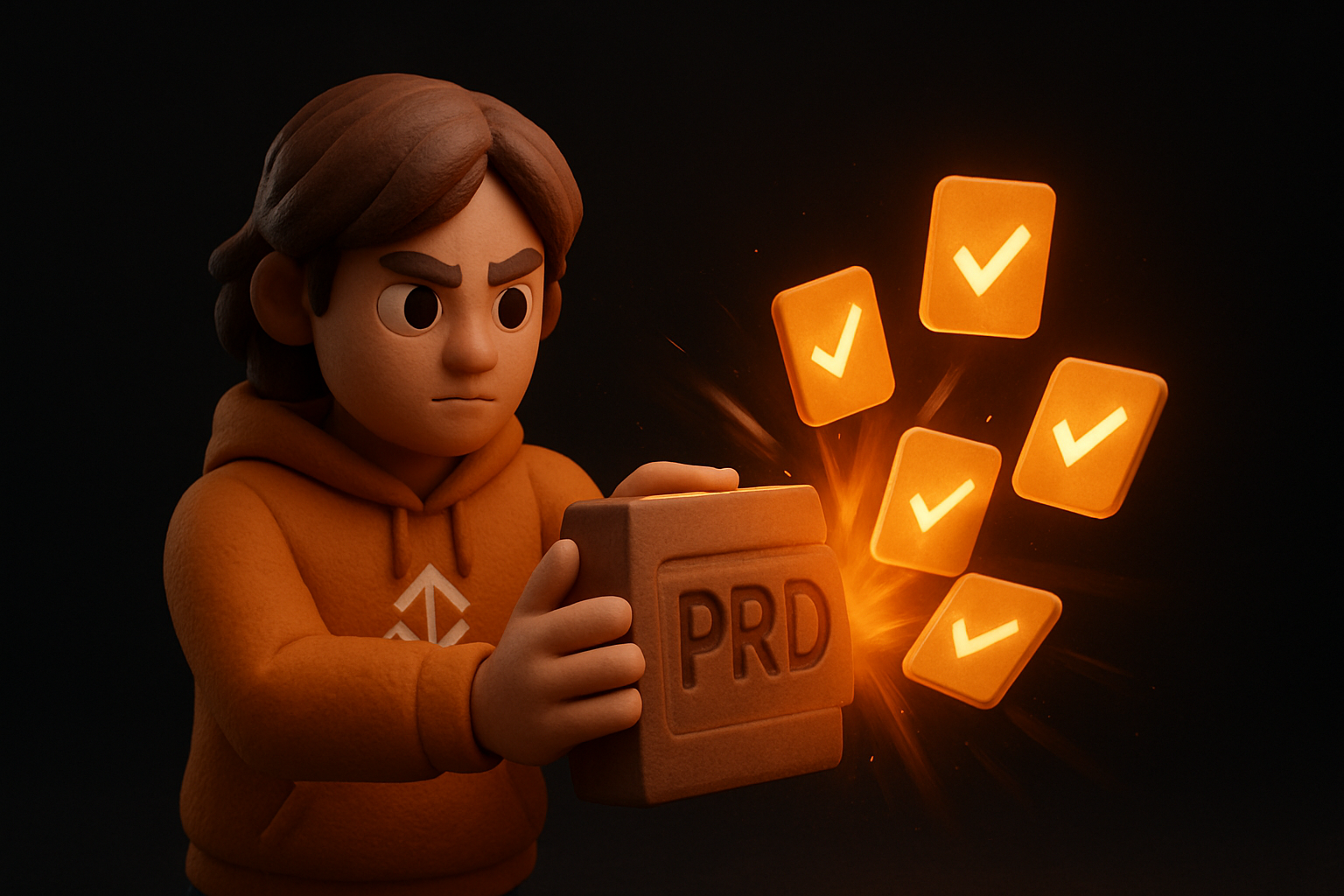
Kevin Kern's technique bridges this gap: use AI to split the PRD into implementation-ready tasks BEFORE using AI to implement them. Two AI steps instead of one, but dramatically better output.

The Splitting Prompt

The two-step technique for turning PRDs into AI-friendly tasks.

1

Feed the PRD to AI with the splitting prompt

Paste your PRD and ask: 'Split this PRD into sequential implementation tasks. Each task should be completable in one coding session (30-60 min). Include: task name, files involved, acceptance criteria, and dependencies on other tasks. Order by implementation sequence.'

2

Review and adjust the task list

The AI produces 8-15 tasks from a typical PRD. Review for: correct ordering, reasonable scope per task, no missing functionality. Adjust task boundaries if some are too large or too small.

3

Execute tasks sequentially

Work through tasks one at a time. Each task becomes a focused AI coding session with clear scope and acceptance criteria. The AI's output quality is dramatically higher because each prompt is well-scoped.

Applying the Technique

Works with Any AI Tool

The splitting step can use any AI (ChatGPT, Claude, Gemini). The implementation steps use your preferred coding tool (Cursor, Claude Code, Codex). The technique is tool-agnostic.

Better Than Manual Task Breakdown

AI is surprisingly good at identifying implementation sequences and dependencies. It often suggests a more logical order than manual breakdown because it considers technical dependencies humans might miss.

Creates a Natural Commit History

Each task maps to one commit or PR. This creates a clean, reviewable history where each change has clear scope and purpose. Much better than one massive 'implement feature X' commit.

More resources

On this page