Agentic AI change large-scale enterprise system development lifecycle

The reality of building and operating large enterprise systems is brutal: hundreds of thousands of requirements, endless integrations, round-the-clock operations. Most AI for software development stops at "vibe coding" — assistants that autocomplete snippets or refactor files. A newer class of platforms is pushing beyond that edge: agentic AI that lives in the editor and terminal, reading files, running commands, and building features through supervised autonomy. This post is about that shift — agentic AI planted at the heart of the entire software development lifecycle, orchestrating not just code but analysis, design, delivery, and operations.
What is agentic AI and how does it transform large-scale system development?
Agentic AI, in the enterprise context, denotes AI agents with goal-driven autonomy: they do not just predict completions for developer edits, but orchestrate workflows, break down specifications, analyze requirements, and coordinate actions across a complex software project. Tools like Cline — an AI coding agent that reads and writes files, runs terminal commands, and acts only with explicit approval — show the baseline pattern: the agent does real work in the real repo, with the human in the approval loop.
Unlike traditional AI coding assistants — which hover at the IDE layer and handle suggestions or mundane edits — agentic AI aims to run the show across the full lifecycle. In the spec-driven enterprise model, agents operate from the earliest analysis and design stage, move through code generation and quality assurance, and hand off to operations, forming a complete loop. Their autonomy encompasses not just coding, but driving a specification-driven process end to end.
This leap matters because large-scale systems are not just big; they are too complex for fragmented, code-first AI to handle. Agentic AI promises a genuinely new model — where the AI is not a coding sidekick but an orchestrator, able to understand, plan, and execute at the level of system design and business requirements. The contrast with hand-ops habits is stark, as I have written in AI agents vs manual deployment.
How do AI agents orchestrate the full software development lifecycle?
AI agents in this model do not just solve isolated tickets. They string together the full chain:
- Requirements analysis: parsing business inputs, policies, and constraints at scale.
- Design: translating requirements into formal architectures, breaking work into discrete deliverables, and planning integrations.
- Coding: automating not just generation, but adherence to spec and compliance needs.
- Quality assurance: running and correlating tests, identifying regressions, and ensuring continuous delivery.
- Operations: monitoring live systems and feeding operational insights back into future phases.
A spec-driven agent hooks into each phase, automating the transfer of knowledge and deliverables between them. Its intelligence is not surface-level: it works from and reinforces precise specifications — drawing on requirement docs to generate design artifacts, generating code against those specs, and continuously checking that deployed systems conform to original intent. Quality, in this paradigm, is not bolted on; it is inherent in the orchestration.
Integration with existing enterprise workflows is crucial. Rather than demanding greenfield processes, the agent layer anchors to a knowledge foundation (see next section) and slots into real CI/CD pipelines, ticketing systems, and monitoring surfaces. The payoff vendors in this space consistently describe is agility plus reliability: automation permeating every stage squeezes out the hand-off errors and misalignments that destroy schedule and budget. That delivery angle is the same one covered in AI agents in software delivery.
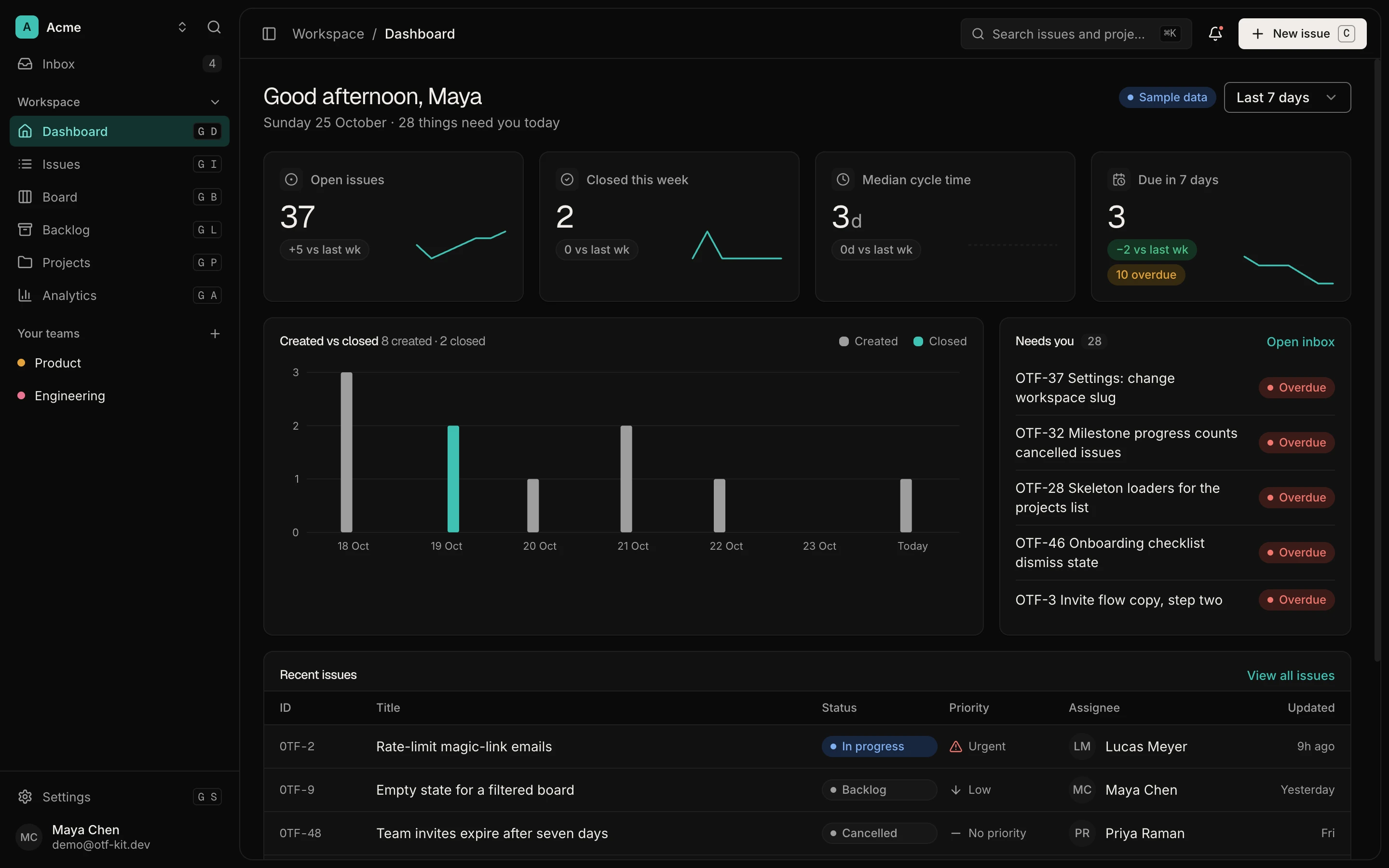
12 production screens. Login and database wired.
The SaaS Dashboard Kit includes login, a database, and a working dashboard. Live demo at saas.otf-kit.dev.
What is the role of knowledge-foundation AI in enterprise systems?
Most off-the-shelf enterprise AI tools work by shallowly imitating common coding patterns or using pretrained models that lack domain fluency. Knowledge-foundation AI takes the opposite tack: it is loaded with a deep, tailored representation of the enterprise's systems, operations, and business logic.
In practice this means formalizing and continuously ingesting operational knowledge, system specs, and business rules into a unified, queryable model that agents consult and refine — grounded in documented enterprise reality, not just generic code patterns. This enables several things:
- The AI can translate business policies and compliance rules into technical implementations without translation loss.
- It can monitor operational data and recommend (or deploy) proactive fixes, not just reactive patches.
- When a new requirement lands, the AI knows how it fits into the existing system context and can orchestrate changes that will not break established guarantees.
Enterprises burn time and budget bridging the gap between what the business needs and what engineering delivers. Rooting agent logic in the actual, evolving knowledge base of the organization makes every phase of development more responsive and reliable. None of this works without guardrails, which is why a governed AI coding platform matters: autonomy without policy is just faster chaos.
How does spec-driven enterprise orchestration work?
The workflow, as described by vendors shipping in this space and consistent with how supervised agents like Cline operate with explicit per-action approval:
- Specification ingestion: the agent consumes formal specs, requirement docs, and operational artifacts.
- Analysis and planning: it translates those inputs into technical plans — architectures, service boundaries, resource allocations.
- Development orchestration: the agent decomposes specs into code generation tasks, assigns priorities, and dispatches work — automating significant portions of implementation and review.
- Integrated QA: the same agents enforce spec alignment through automated tests, validation suites, and code review policies, tightening the link between requirements and shipped code.
- Operational feedback loop: in production, the agent monitors real-world behavior, detects anomalies or mismatches to original intent, and primes future sprints with this intelligence.
Key feature: spec-driven everything. Unlike tools that suggest one-off fixes or surface-level completions, here the spec is the active source of truth. Decisions, code, tests, and deployments all trace back to it. That is the shift: not AI as a codebot, but as a specification-native orchestrator.
For enterprises, this means increased agility (requirement changes propagate with less friction), less defect leakage (requirements and tests stay alive throughout), and higher reliability (monitoring connects real operations with original design intent).
How can developers and enterprises use agentic AI today?
Adopting agentic AI at enterprise scale requires more than a new plugin, but it is achievable:
- Centralize specifications and operational knowledge. Agents must anchor to an authoritative, queryable source — requirement documents, architecture diagrams, and production runbooks in structured, accessible formats.
- Assess workflow integration points. Map your SDLC and CI/CD pipelines for natural handoff spots: where requirements reach developers, where testing occurs, where deployments trigger monitoring.
- Deploy the agent as orchestrator. The agent dispatches work based on specs, manages task queues, issues code review recommendations, and ingests operational telemetry — always under human approval, following the supervised pattern tools like Cline document.
- Iterate under human oversight. Let the AI auto-generate plans and implementations but pass pivotal outputs through human checks; let automation absorb more flow over time.
- Close the loop: feed operational outcomes back into specs. Use agent monitoring to suggest requirement refinements and bugfix proposals automatically.
Expected outcomes: reduced time-to-market since requirements carry through without translation loss, lower defect rates from automated spec-test-code alignment, and more resilient operations as agents reconcile real behavior with intended design.
The next chapter: agentic AI is finally enterprise-grade
Agentic AI for large-scale system development is not speculative. Spec-driven platforms are shipping the template for end-to-end intelligent orchestration: AI as orchestrator, analyst, and operations partner — backed by a live knowledge foundation. This is not another code copilot. It is a full-stack approach to enterprise software development, rooted in live business reality and designed for continuous adaptation.
Enterprises that build and operate complex systems now have a concrete path: formalize your knowledge, let agentic AI drive the lifecycle under supervision, and close the loop between intent and execution. The era of AI as an IDE toy is fading; orchestration is the new baseline.
Build on a foundation agents can actually extend: OTF kits ship tested components, agent configs, and conventions your coding agent follows from the first prompt. Browse the kits →
Sources
- Cline documentation — AI coding agent that reads/writes files, runs terminal commands, and acts with explicit approval; the supervised-agent baseline cited throughout.
- OTF kit templates — production kits with agent-ready conventions referenced in the CTA.
Ship the product, not the setup.
- 12 production screens — auth, team, analytics, and settings
- Login and a real database are wired in
- AI configs pre-tuned so your agent extends instead of regenerates
Ship your first screen tonight — free starter in your inbox
The quickstart, the SDK repo and the live kit demos, on this screen and in your inbox.
No spam. Unsubscribe any time.