Lovable alternatives for an app you can ship

Which Lovable alternative should you pick if the app has to reach real users on a phone? Sort the options by one question: after the first version exists, where does the code live, and which tool keeps working on it with you? Prompt-to-app builders get you a first version fast. Coding agents that work in your own files, started from a kit, are what most people move to when the app needs payments, an app store release and a long life.
If your app is a booking or appointments product, the Booking Kit is the starting code for the agent you already use. It is listed at $99 one-time with a live demo. The rest of this post is for anyone choosing between tools, with every vendor statement dated and linked.
What are the two kinds of Lovable alternative?
The roundups that rank for this search list many tools. They fall into two groups, and the group matters more than the individual tool. We read only the five vendor pages listed under Sources; we did not read Rork, Emergent, v0, Windsurf or Codex, so do not take this list as complete.
Builders you drive with a chat. You describe the app and the product produces it. Lovable, Bolt and Replit belong here by their own descriptions:
- Lovable calls itself "an AI software engineer" and says you can "chat to instantly build websites and web apps" (lovable.dev/pricing, read 24 November 2026).
- Bolt's page reads "Create stunning apps & websites by chatting with AI" and lists hosting and "Bolt Cloud" backend services (bolt.new, read 24 November 2026).
- Replit says it is "the AI platform that helps you turn your ideas into real outcomes" and lists "Authentication, Database, Hosting, and Monitoring" as built-in services (replit.com, read 24 November 2026).
Agents that work on code you hold. You own a repository, and the agent reads and edits it. Claude Code describes itself as "an agentic coding tool that reads your codebase, edits files, runs commands, and integrates with your development tools" (code.claude.com/docs/en/overview, read 24 November 2026). Cursor says it is "your coding agent for building ambitious software" and offers a desktop app and a command-line tool (cursor.com, read 24 November 2026). Its page does not spell out how local and cloud work differ, so check that before you rely on it.

Why does the difference show up late?
At the start the two groups look alike: you type what you want and screens appear. The difference shows up when you need things a prototype can skip.
- A payment flow with a live key and a webhook that has to be set up in production, not only in preview.
- A build you submit to the App Store or Google Play, with your own signing and your own release steps.
- A bug on a customer's phone that you need to trace through code you can run and read.
- A second developer, a code review, a version history.
None of these is a flaw in a builder. They are the point where "the tool made the app" turns into "we run the app". We wrote about one case of it, a Bolt-exported app that passed in preview and then needed a careful Stripe production cutover: Before Bolt subscriptions go live, check the Stripe production cutover.
What do the vendor pages say about taking your code with you?
This is the question to put to any builder before you invest weeks in it, and the pages we read answer it unevenly.
- Lovable's pricing page says you own what you make, including "the apps, websites, and other projects you build with Lovable". It does not mention GitHub sync or code export on that page. We did not read further than that page, so we make no claim about what exists elsewhere on the site.
- Bolt's home page lists GitHub only as a place to start from ("or start from" Figma, GitHub or a team template). It does not say whether code is pushed back to GitHub, and it does not mention exporting code.
- Replit's home page does not say where apps are built or hosted. It lists hosting as a built-in service.
"Not mentioned on the page" is not "not possible". It means you should find the answer in the vendor's documentation before you commit, and test it with a throwaway project: can you get the whole app into a repository you control, and does it build and run there without the vendor's product?
What about price and growth numbers?
We are not quoting plan prices or revenue and user figures for any of these tools. Our own research notes say sources disagree on them, and a number we cannot pin to a dated vendor page does not belong in this post. Open each vendor's pricing page on the day you decide.
Where does an OTF kit fit?
A kit is not a competitor to Lovable in the sense of generating an app from a sentence. It is a repository of working code, written for a coding agent to continue. That is the second group above, with a head start.

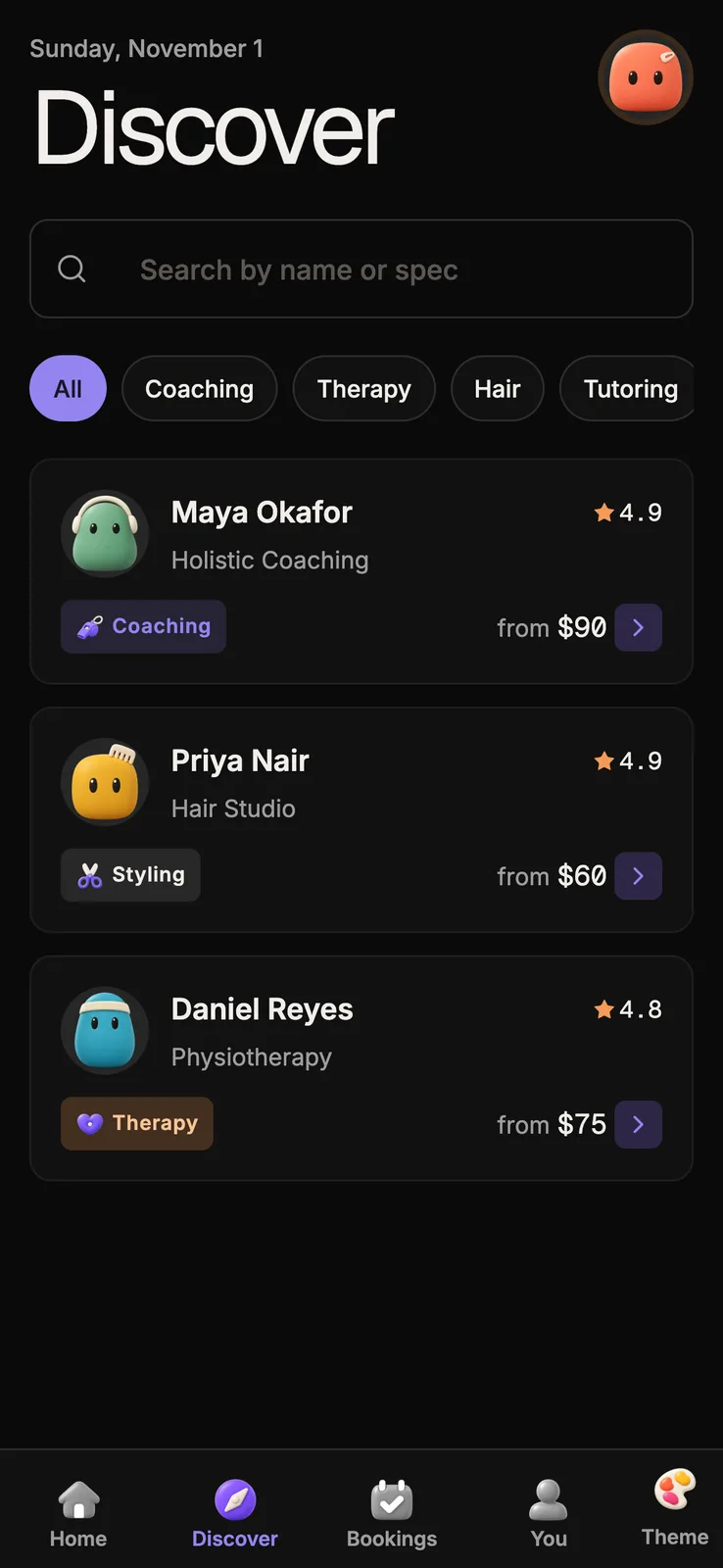
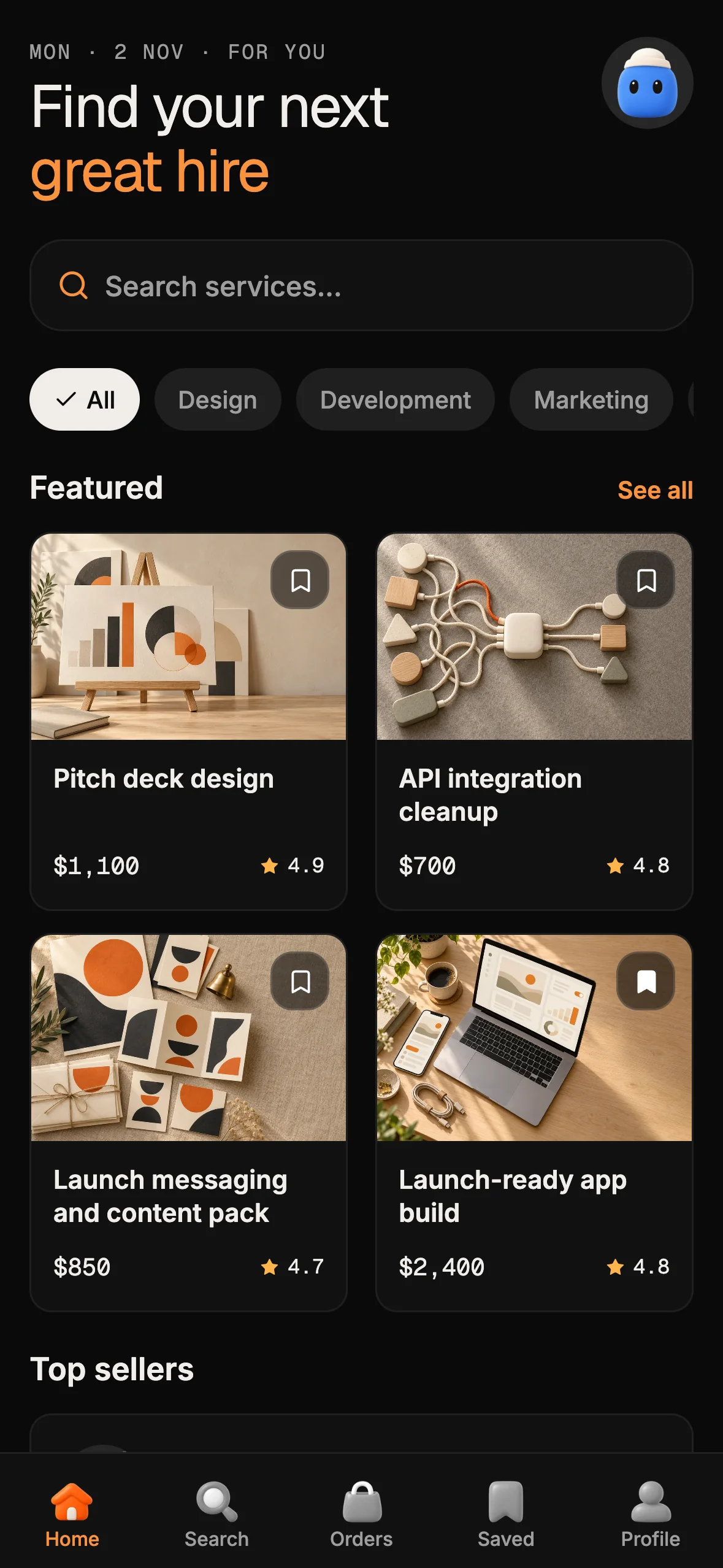
The Booking Kit page (read 27 November 2026) lists 13 screens, including provider discovery, service detail, a month calendar, a realtime slot picker, Stripe checkout and a booking ticket with a QR code. The stack on the page is Expo SDK 58, React Native 0.88, TypeScript 6.0, an API server and Supabase Postgres, with one codebase for iOS, Android and web. For release it names EAS Build for the app stores, and Supabase with Cloudflare Workers or Docker for deployment. The page says the repo ships CLAUDE.md, .cursorrules, a custom Claude skill and 20 task prompts. Those are files that Claude Code and Cursor read at the start of a session, so your agent begins with the rules of the project instead of guessing them.
What that does and does not give you:
- It gives you code you can read, run and change, a named backend, and written instructions for the agent.
- It does not give you a finished product for your market. You still decide what to keep, test the payment flow with your own Stripe account, and run the release.
- It does not apply if your app is not close to a booking product. The page names what is in the kit; compare it with your brief and use the live demo before paying.
How do the license and the sale terms work?
The pricing page (read 27 November 2026) lists all six kits at $99 one-time, and the Everything Bundle at $149 for all six kits and the 20 landing templates, shown as a founding price. The kit license, in LICENSE-KIT.md in the repo, gives a single developer the right to use, modify and ship the kit code in personal and commercial products, with as many end customers as you like. You may not resell or redistribute the kit code, or republish it as a starter or template. Sharing it with developers outside your team needs additional seats. The pricing page says all sales are final except where required by law, so run the demo and read the license before you pay. Current prices are on the pricing page.
How should you choose?
- Write what the app must do at launch: payments, accounts, push notifications, an App Store listing.
- Ask each builder, in its documentation, how you get the full code into your own repository, and test it once.
- Decide who will maintain the code in six months. If it is you and an agent, plan for a repository from the start.
- If the product is a booking app, open the Booking Kit demo and compare its screens with your list.
- If you are unsure which category a library or kit falls in, see how we compare other starting points on the comparison pages.
A builder is a reasonable way to find out whether an idea is worth building. A repository, a kit and an agent are a reasonable way to keep building once it is.
FAQ
Is a kit a Lovable alternative?
It is an alternative for a different job. A builder generates a first version from a chat. A kit gives your coding agent working code to extend. Choose by whether you want the first version generated or the long-term code started well.
Can I use Claude Code or Cursor with the Booking Kit?
The kit page lists CLAUDE.md, .cursorrules, a custom Claude skill and 20 task prompts. We have not measured how well any agent follows them on your task.
Does Lovable let me export my code?
The pricing page we read does not say. Check Lovable's documentation and test with a small project before you rely on it.
What does the Booking Kit cost?
$99 one-time, listed on the kit page and the pricing page on 27 November 2026. The pricing page says all sales are final except where required by law.
Sources
Vendor pages read 24 November 2026; OTF pages read 27 November 2026.
- https://lovable.dev/pricing
- https://bolt.new
- https://replit.com
- https://code.claude.com/docs/en/overview
- https://cursor.com
- https://otf-kit.dev/templates/booking-kit
- https://otf-kit.dev/pricing
- https://otf-kit.dev/blog/bolt-exported-app-stripe-live-cutover
- Kit license: kits/booking-kit/LICENSE-KIT.md in the OTF repository
Ship your first screen tonight — free starter in your inbox
The quickstart, the SDK repo and the live kit demos, on this screen and in your inbox.
No spam. Unsubscribe any time.