
Paywall conversion for first paid users starts with one promise and one gate

First paid conversions climb when the paywall sells one concrete promise and the app enforces one entitlement gate — not when you stack every offer the stores allow on day one.
Store subscription tooling is generous. Apple documents freemium apps, metered paywalls, free trials, pay-as-you-go and pay-up-front offers, win-backs, and Family Sharing on the same auto-renewable subscriptions surface. Google Play expects you to configure subscriptions, base plans, and offers in that order, with transparent terms and a clear cancel path in Create and manage subscriptions. That richness is useful after you know what paid users actually buy. For the first cohort, it is noise.
What “first paid users” really means
Treat the first paid users as people who already completed one valuable free action, then hit a single locked capability that matches the paid tier you priced.
That is a different problem from “raise paywall conversion rate” in the abstract. A/B testing paywall copy and placement matters once traffic exists; the sibling guide on changing one paywall variable at a time covers that loop. Pricing the tier as a keepable promise belongs in first-tier pricing. This post sits between those two: what the sheet must say, what the binary must gate, and which funnel events prove the story before you open a second SKU.
If a new user can reach paid features through a second path, or the sheet lists four unrelated benefits, you are not measuring conversion — you are measuring confusion.
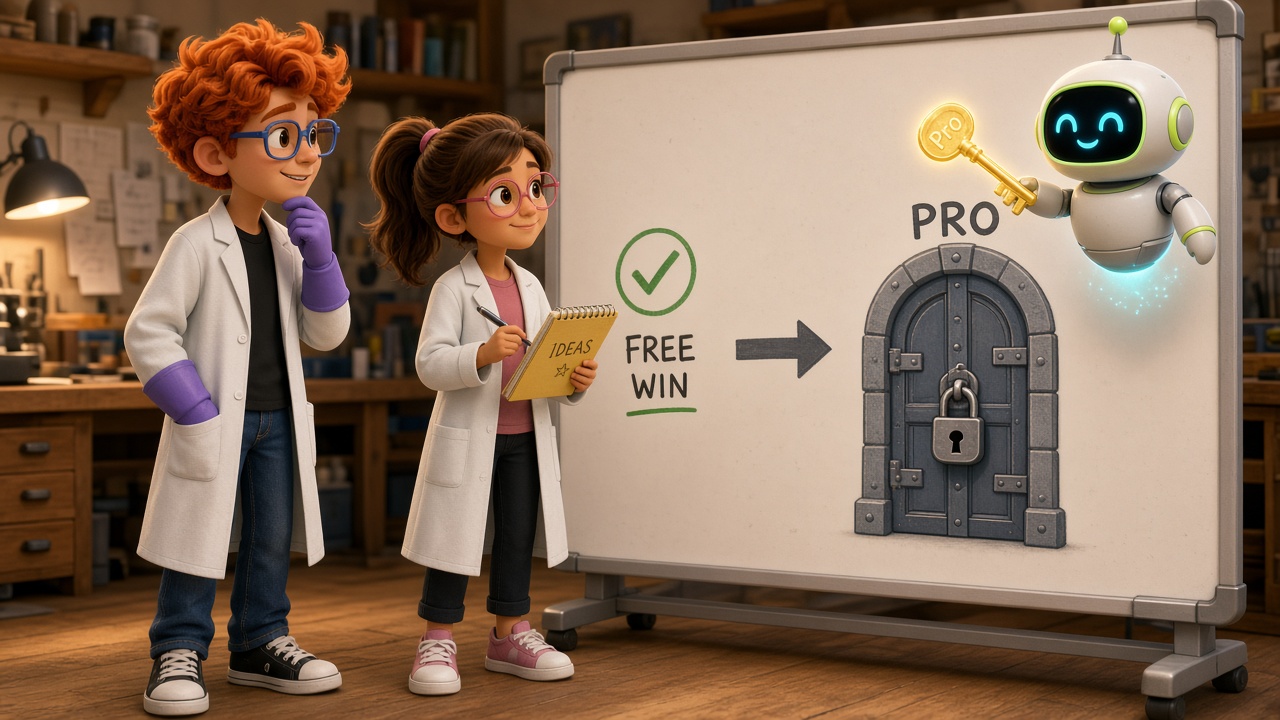
Pick one entitlement, not a feature dump
Name the paid enable as a single entitlement string your client and server both understand, for example pro or team_seats. Every paid screen, API route, and agent prompt checks that same key.
type Entitlement = "free" | "pro";

export function requirePro(user: { entitlement: Entitlement }) {
  if (user.entitlement !== "pro") {
    throw new Error("pro_required");
  }
}
Apple’s subscription guidance pushes ongoing value and clear grouping: people can hold only one subscription inside a group at a time, so a single group is the default for most apps. Google’s Play Console flow likewise forces a subscription product before base plans and offers. Both platforms assume you already decided what the paid product is. Mirror that decision in code before you design the sheet.
Do not gate “everything interesting.” Gate the capability that makes the free tier feel incomplete after a real win — export, multi-seat, unlimited runs, or production deploy hooks. Soft-lock adjacent chrome so free users still finish the first win without a dead end.
11 production screens. Login, database, payments — all wired.
The SaaS Dashboard Kit ships everything already connected. Nothing to set up. Live demo at saas.otf-kit.dev.
Write the sheet like a receipt, not a brochure
Apple requires the sign-up screen to show subscription name and duration, what the period includes, the full renewal price as the most prominent price element, and a path for current subscribers to restore. Free trials must state trial length and the price after the trial. Google requires explicit offer terms, billing frequency, cost, and an easy cancel path; benefit lines must describe features, not “Try 7 days free.”
Use that checklist as the sheet outline:
- One headline that restates the entitlement in plain language.
- Two or three benefit lines that name outcomes the free tier already proved.
- Billing amount (and trial end price if any) as the largest price text.
- Restore / manage / cancel affordances that match store policy.
export function PaywallSheet({ priceLabel }: { priceLabel: string }) {
  return (
    <section aria-labelledby="paywall-title">
      <h2 id="paywall-title">enable Pro exports</h2>
      <ul>
        <li>Keep the projects you already shipped</li>
        <li>Export without the free-tier watermark</li>
        <li>Share with one teammate seat</li>
      </ul>
      <p className="price">{priceLabel}</p>
      <button type="button">Subscribe</button>
      <button type="button">Restore purchases</button>
    </section>
  );
}
Apple also notes that annual plans should lead with the billed annual amount; equivalent monthly math stays visually subordinate. Follow that hierarchy even when your marketing instinct wants “only $X/mo” as the hero. Mis-ranked price copy is a review and trust problem, not a growth hack.

Freemium, metered, or hard gate — choose one path
Apple describes three acquisition patterns that still work for AI-built products: brief onboarding that highlights subscription value, freemium with optional deepen, and a metered paywall that grants a finite free quota before purchase. Google’s new-customer offers add free trials and discounted phases after the base plan exists.
For first paid users, pick one pattern and instrument it:
- Freemium: free forever for the core loop; paywall only on the entitlement.
- Metered: N successful free runs, then the same sheet.
- Hard gate after onboarding: only when the free loop cannot prove value without paid infra.
Stacking a metered limit and a hard wall and three introductory offers in week one hides which lever moved. Keep introductory offers to a single territory-safe trial once the base conversion path is stable.
How to instrument the first conversion loop today
Ship four events with shared properties (plan_id, entitlement, trigger, platform):
type FunnelEvent =
  | { name: "activation_completed"; props: { action: string } }
  | { name: "paywall_viewed"; props: { trigger: string; entitlement: string } }
  | { name: "purchase_started"; props: { plan_id: string } }
  | { name: "purchase_completed"; props: { plan_id: string; entitlement: string } };

export function track(e: FunnelEvent) {
  // your analytics sink — same schema on web and mobile
  console.info(e.name, e.props);
}
Definition of done for the first cohort:
activation_completedfires on the free win you care about.paywall_viewedfires only from that win’s next action (or meter exhaustion).purchase_completedwrites the entitlement before any paid UI enables.- Restore and cancel paths are reachable without support tickets.
Apple’s subscription analytics (retention, offer conversion, cancellation reasons) and Play’s subscription reporting become useful after this spine exists. Without it, store dashboards describe store behavior, not your product promise.
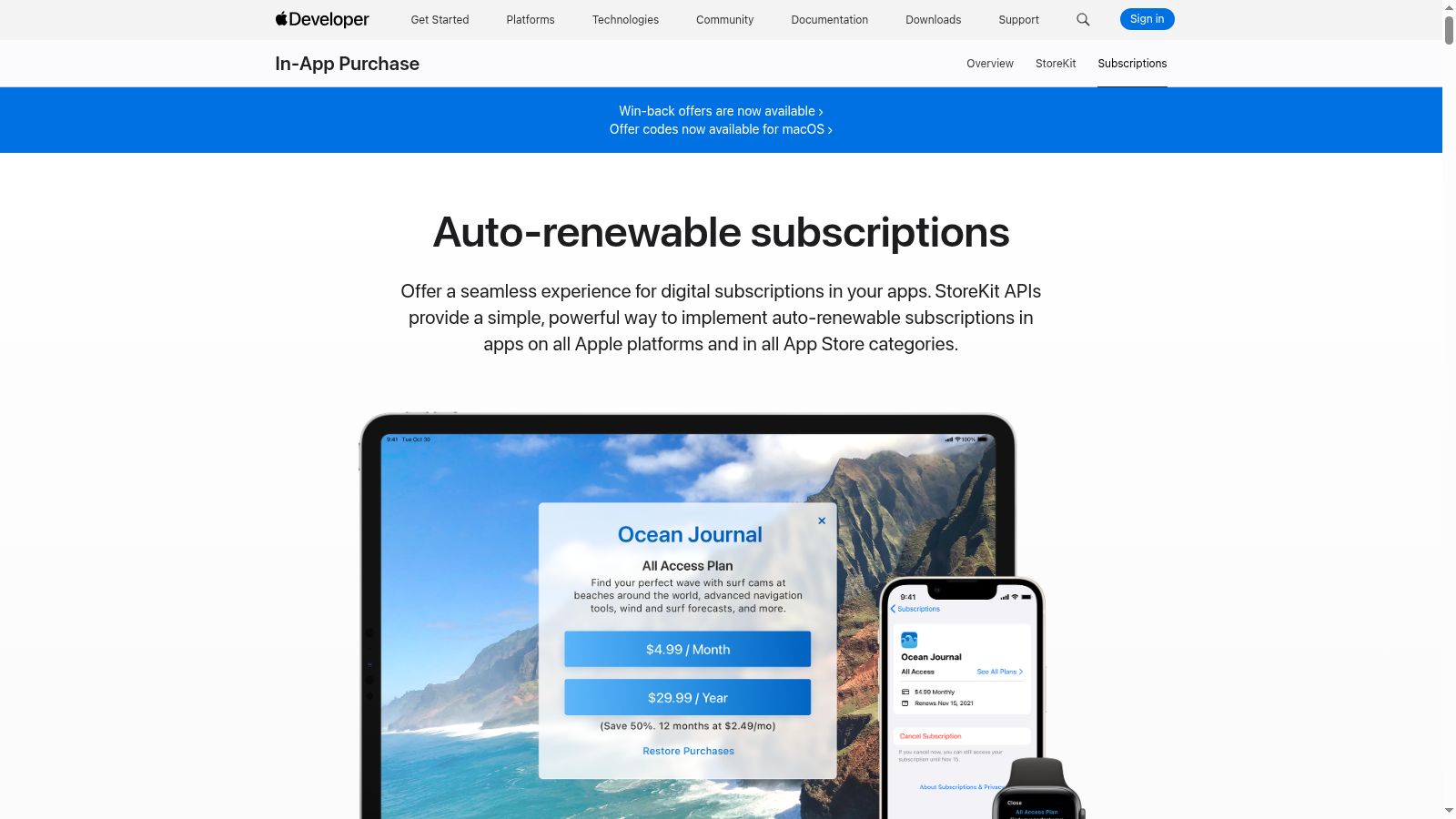
Source: developer.apple.com/app-store/subscriptions, captured 2026-09-17.
Server-side, prefer store server notifications / Play Real-time Developer Notifications so entitlement flips are not “trust the client.” Client UI can optimistic-render; authority stays on the receipt or purchase token you verify.
Common failure modes before the second SKU
Benefit salad. Four unrelated bullets train users to skim. Cut to the outcomes the free win already demonstrated.
Second gate. A web checkout, promo code, or hidden settings toggle that also enables Pro breaks entitlement truth and App Review expectations around digital enables.
Offer archaeology. Leaving expired introductory copy on the sheet while the base plan price changed teaches distrust. Apple and Google both expect clear current terms.
Conversion theater. Celebrating paywall CTR while activation→purchase collapses usually means the trigger was too early. Move the sheet later in the free win, not louder on launch.
Lane confusion. Implementation details for a specific purchase SDK belong in the entitlements-first paywall wiring guide. Keep this strategy post free of SDK tourism so the decision stays portable across web and store builds.
Ship the promise with an owned repo
When the paywall story is one entitlement and one sheet, an owned starter kit helps because auth, billing hooks, and agent prompts live in the same repo your editors keep extending. The templates catalog is one place to start from a wired SaaS or fitness surface instead of regenerating checkout chrome every sprint. Pair that with the launch checklist for AI-built apps so store metadata, privacy labels, and the paywall sheet land in the same release train.
First paid users do not need a clever portfolio of offers. They need a free win, a single locked capability, a sheet that reads like a receipt, and events that prove the path. Add A/B tests and win-backs after that spine holds.
Sources
- Apple — Auto-renewable subscriptions
- Apple — App Review Guidelines (Business / subscriptions)
- Google Play — Create and manage subscriptions
Ship the product, not the setup.
- 11 production screens — auth, billing, team, analytics, settings
- Real database, payments, and login — all wired on day 1
- AI configs pre-tuned so your agent extends instead of regenerates