
AI coding tools fuel 60% surge in global app launches

Global app launches are up 60%, according to a World Today Journal report tying the surge directly to AI coding-tool adoption. Read the number the way it is presented: one outlet's figure, attributed to unnamed "industry analysis and platform metrics," published August 2, 2026 — not a peer-reviewed dataset. The honest version of the claim is narrower but still interesting: multiple platform signals point the same direction, and the mechanism behind them is concrete enough to plan around.
That mechanism is worth pausing on. Not "more PRs opened." Not "more repositories created." AI coding tools absorbed the most repetitive parts of shipping software — boilerplate generation, test scaffolding, natural-language-to-script translation — and moved the bottleneck. It used to be "how do we write all this code." Now it is "how do we make sure what we wrote actually holds up." That part is worth talking about.
What is actually driving the number
The mechanics are unglamorous and that is why they work. GitHub Copilot, Cursor, and the AI assistants wired into modern IDEs handle the parts of software development that have always been the worst: typing out the same CRUD handler for the hundredth time, writing the test scaffolding nobody enjoys, spelunking through a legacy codebase to figure out which function imports what. GitHub's own positioning — millions of users, large self-reported productivity gains — corroborates the direction of travel even though it does not confirm any 60% figure.
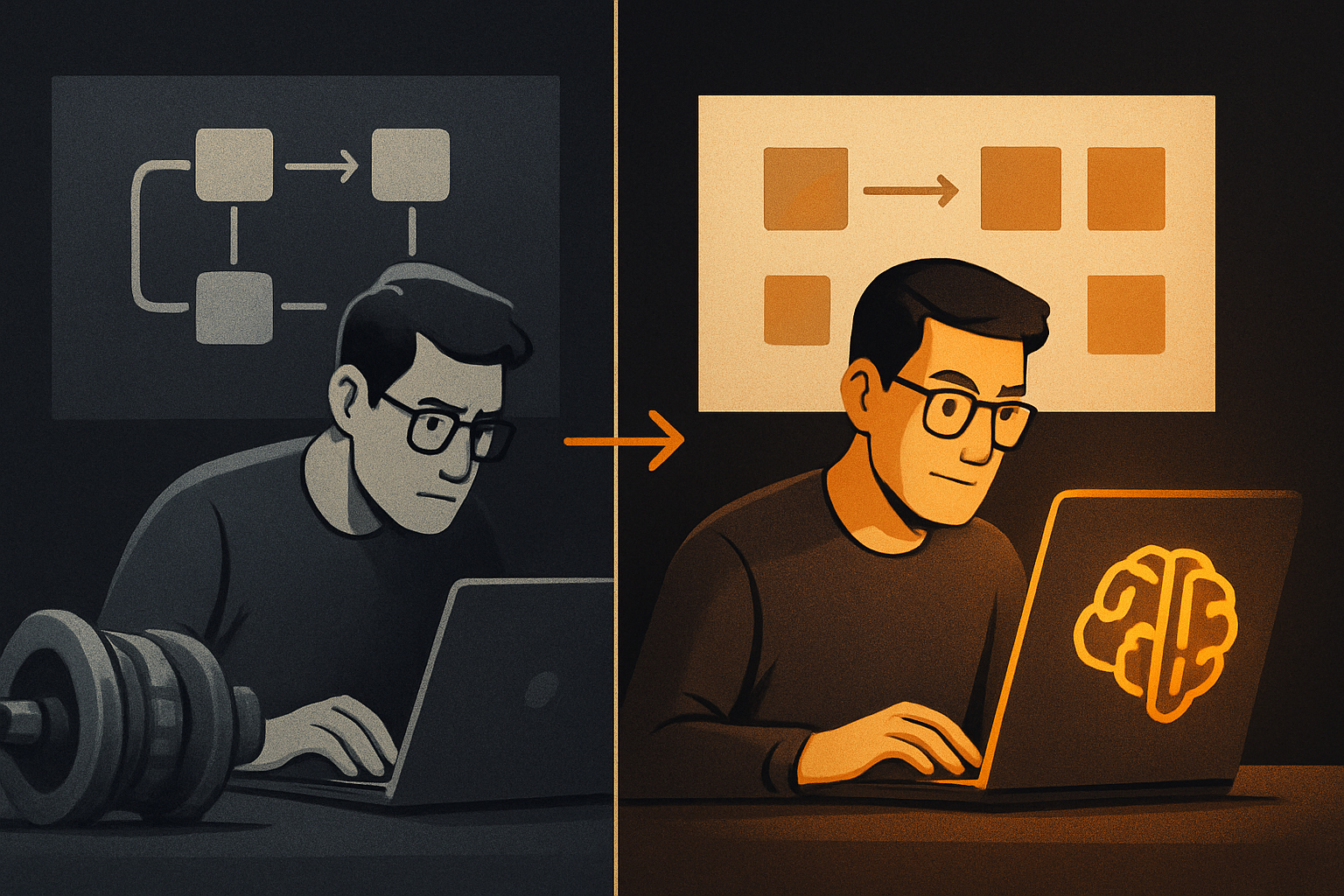
When that work moves from human to model, the developer's day changes shape. You stop being a typist and start being a reviewer. You stop writing boilerplate and start arguing about whether the boilerplate is correct. That cognitive shift — syntax offloaded, judgment retained — is what enables the velocity.

Expect the gains to be uneven by category, as a matter of reasoning rather than measured data: work that is mostly boilerplate has the most to automate, while correctness-unforgiving systems work has the least. Any headline aggregate blends both. Treat the 60% as a directional signal about where the industry is heading, not a precise measurement of any one team's experience — and if you are turning velocity into shipped product, run it through a production checklist built for AI-assisted output before calling it done.
Where AI is good, and where it breaks
Not every task is a fit. Here is the working split after sustained shipping with these tools:
// Good fit: deterministic, pattern-heavy, low blast radius
const handlers = ai.generateCRUDHandlers(schema)        // saves hours
const tests    = ai.scaffoldTestCases(module)           // saves an hour
const migrate  = ai.translateLegacySyntax(oldFile, 'ts') // saves days
// Bad fit: correctness-critical, security-sensitive, novel architecture
const authFlow = ai.implementOAuthForOurBackend() // do not ship without review
const cryptoRoutines = ai.writeOurTokenSigning() // absolutely not
const schemaDesign = ai.designOurDatabaseForScale() // useful as a draft, not a planThe line is "low blast radius" versus "high blast radius." Boilerplate fails visibly and is easy to revert. Auth fails silently and ships to production. Use the tools where the failure mode is loud.
One codebase. iOS, Android, and web.
The Fitness Kit ships with auth, a database, and a backend already connected — no setup. Live demo at fitness-preview.otf-kit.dev.
How to actually use this today
A concrete setup that works, end to end. For IDE-bound work, Cursor with a frontier model and review-on-diff enabled:
# Install Cursor + wire up the two providers you'll actually use
brew install --cask cursor
export ANTHROPIC_API_KEY=sk-ant-...
export OPENAI_API_KEY=sk-...
// ~/.config/cursor/settings.json
{
"ai.reviewOnDiff": true,
"ai.testGeneration": "auto",
"ai.blockOnSecrets": true
}For terminal-native workflows — ad-hoc refactors, one-off migrations, batch transformations — a short script calling the same model does the job:
import os, anthropic, pathlib

client = anthropic.Anthropic()

def migrate_legacy(src: str, target: str) -> str:
    msg = client.messages.create(
        model="claude-sonnet-4-5",
        max_tokens=4096,
        messages=[{
            "role": "user",
            "content": (
                f"Translate this {src} file to idiomatic {target}. "
                f"Preserve behavior exactly. Flag any behavior you cannot "
                f"preserve with a `// UNCERTAIN:` comment.\n\n"
                + pathlib.Path(src).read_text()
            ),
        }],
    )
    return msg.content[0].text

if __name__ == "__main__":
    import sys
    print(migrate_legacy(sys.argv[1], sys.argv[2]))
The teams capturing the surge are not running one tool — they are running the same model across editor, terminal, CI, and review. The velocity gain compounds when the model is everywhere.
The security layer you cannot skip
The same coverage that reports the surge flags the obvious risk: AI-generated code can propagate insecure patterns. SQL injection templates, missing input validation, the OWASP top 10 appearing again because the training data contained them. When you ask a model to "write me a user login endpoint," you get something that looks right. It might not be. The pattern the model learned from a tutorial years ago is now in your codebase.
This is not a reason to stop using the tools. It is a reason to layer review on top — and to keep shipping quality observable after release with production error tracking, because some AI-introduced defects only surface under real traffic.
# .github/workflows/ai-review.yml
name: ai-review
on: [pull_request]
jobs:
  review:
    runs-on: ubuntu-latest
    steps:
      - uses: actions/checkout@v4
      - run: pip install bandit semgrep
      - run: semgrep --config=auto --error .
      - run: bandit -r ./src -lll
# Local pre-commit, blocks secrets and obvious foot-guns
git config core.hooksPath .githooks
cat > .githooks/pre-commit <<'EOF'
#!/usr/bin/env bash
grep -rnE 'AKIA[0-9A-Z]{16}|-----BEGIN .* PRIVATE KEY' . && exit 1
EOF
chmod +x .githooks/pre-commitStatic analysis, secret scanning, mandatory review for anything touching auth or payments. The teams riding this wave are not skipping review — they have automated review too, and they treat the model's output the way they would treat a junior engineer's PR: useful, fast, but never ground truth.
The part that does not change when the model does
Here is what the surge surfaces that nobody talks about enough: every one of those apps still has to ship to web, iOS, and Android. The model that wrote the code in March will not be the model writing it in September. The IDE will change. The pricing will change. The whole tooling layer is in motion.
What is stable is the surface you are shipping to. The button has to look and behave the same on a phone and a monitor. The form has to respect the platform's accessibility tree, not the model's approximation of it. The component has to render correctly whether it was generated by any model or your own engineer at 2am.
That is the durable layer. One component, expressed once, shipping to every surface your faster pipeline produces. When the AI tool changes next quarter — and it will — your UI does not have to. The energy you save on tooling churn gets spent on the actual product, which is exactly what OTF's templates are built for: one shared component layer across web and native, so velocity compounds instead of rebuilding your UI every six months.
Build the durable layer first. Let the tooling churn on top of it.
Sources
- World Today Journal, "Global App Launches Surge 60% as AI Coding Transforms Software Development" (Linda Park, 2026-08-02; 60% attributed to unnamed industry analysis and platform metrics): https://www.world-today-journal.com/global-app-launches-surge-60-as-ai-coding-transforms-software-development/
- GitHub Copilot — adoption and productivity framing; corroborates direction, not the 60% figure: https://github.com/features/copilot
Stop wiring. Start shipping.
- Login, database, and backend already connected — nothing to set up
- iOS + Android + web from one codebase
- AI configs pre-tuned + 40+ tested prompts included