
How OTF's Fitness kit ships iOS, Android, and web from a single Expo codebase
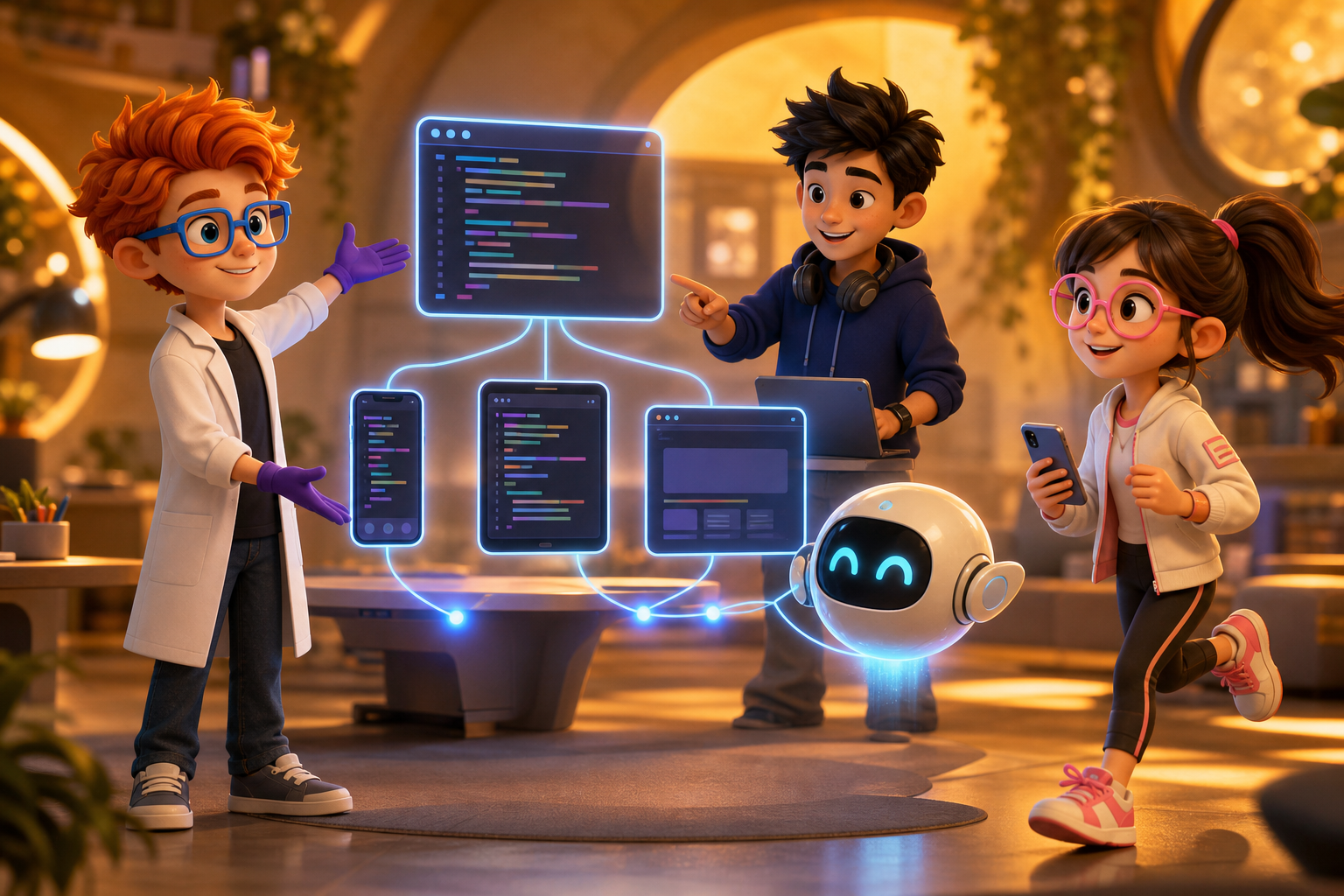
Building for web, iOS, and Android isn't a luxury anymore. Users expect your new SaaS, marketplace, or personal project to work everywhere — not "coming soon" banners. This used to mean three codebases, three design systems, three test matrices, and three times the surface for every bug and changelist. The OTF Fitness kit changes that math: one Expo codebase ships to web, iOS, and Android — and the code you write to add a workout, paywall, or feed ships the same everywhere. The live demo is running today at fitness-preview.otf-kit.dev.
This is hard. Getting one codebase to materialize as a proper app — pixel for pixel, native look, and touch feel on all three surfaces — forces choices at every layer. It's not a "compile to mobile" magic trick. But it's not theoretical either: the preview above is the kit running, and the same source produces the native builds.
The thesis: shipping the same source to real web, iOS, and Android — with the same design tokens, component APIs, and logic — halves the moving parts a solo or small team faces. There are edges, but the payoff is real.
What the same-codebase approach enables
Forget for a second the technical curiosity. For a solo builder or small team, every duplicate surface (separate iOS and Android code) isn't just annoying — it's extra dead weight. More code to keep updated. More divergent styling. More places for small changes to slip out of sync.
With a single repo driving all three platforms:
- Add a new workout screen? It lands everywhere.
- Refactor a hook? One pass, no porting.
- Tweak a theme color or fix a spacing nit? The change is visible instantly on the devices you care about.
The unit of change gets smaller and the cost of change crashes. Everything you test and ship feels lighter and more maneuverable.
One component, everywhere: banishing platform splits
In most open-source projects that claim "cross-platform", the moment you need polish, you hit files like Button.web.jsx, Button.ios.jsx, and Button.android.jsx. Divergence creeps in. The OTF outcome is different: related components such as <Button> and <Card> use documented, platform-specific props and rendering; shared tokens help keep the visual language coherent. The component contract behind this is documented in one component API, and the architecture around it in same component, web and mobile.
You never need to write this:
// common—antipattern with most stacks
import ButtonWeb from './Button.web'
import ButtonIOS from './Button.ios'
import ButtonAndroid from './Button.android'

// then patch up divergent APIs manually
With OTF's kit, it's always:
// One Button that looks and behaves the same everywhere
import { Button } from '@otfdashkit/ui-native'

<Button variant="primary" size="lg" icon={<Check />} />
This outcome is non-trivial. Behind the scenes, each platform's actual base (web or mobile) primitives are used, but that abstraction never leaks unless you go looking for it. You focus on what the component is, not where it runs.
One codebase. iOS, Android, and web.
The Fitness Kit is a mobile starter with its own API, with sign-in and a database. Live demo at fitness-preview.otf-kit.dev.
Theming and tokens: flipping styles globally
A recurring pain with prior cross-platform toolchains is keeping the shadows, border radius, and color palette truly in sync between web and mobile — much harder than it sounds. OTF ships design tokens as the atomic layer of the design system. You change one value (color.primary = '#006BFF'), and every button, card, nav rail updates everywhere — iOS, Android, and web — without hunting for theme folders.
A single theme file for all platforms:
// tokens.ts
export const color = {
  primary: "#006BFF",
  surface: "#ffffff",
  background: "#F6F7F9",
}

// Usage in any component
<Button style={{ backgroundColor: color.primary }}>Go</Button>
Change it once, verify in a single run, and ship with confidence. No divergence between Figma, the web build, and either native app.
Truths and tradeoffs: where one codebase holds or breaks
It's dishonest to claim this is "perfect". Three realities you can't paper over:
-
Platform idioms are real. Users expect modals, navigation, and input to match what their OS provides. Native navigation feels different than a browser tab. OTF's kits abstract this by shipping platform-sensitive primitives where needed. But there are divergences: gesture navigation is handled natively; some drag-to-dismiss gestures "just work" on mobile, not web.
-
Form factors force design choices. A workout tracker's big chart may suit landscape tablets, but squeeze on an iPhone mini. Responsive design is necessary — but the same tokens and layout system can power all variants from the same code.
-
Build and deploy quirks persist. The codebase is unified, but mobile builds still require Xcode for iOS and the Play Store pipeline for Android. You can ship all three from one source, but not from one binary. OTF's ship scripts automate the boilerplate, but you need each platform's tools for the last mile. Our production error-tracking setup covers what happens after those builds reach real devices.
The core: The single-codebase approach works as long as you honor where platforms really differ and keep the abstractions honest. Where the physical device demands a split, OTF exposes APIs to plug in a platform-specific chunk, but you rarely need them.
Setup: from install to device in minutes
Here's the actual sequence to go from a fresh repo to three real apps. No boilerplate — just npm and Expo tooling.
# 1. Clone the OTF Fitness kit
git clone <kit-repo-url> my-fitness-app
cd my-fitness-app

# 2. Install dependencies
npm install

# 3. Start in Expo: runs iOS, Android, and web simulators in one shell
npm run start

# 4. For production: web output plus native builds per platform
npm run build:web    # Generates the web output
npm run build:ios    # Builds the native iOS app (requires Xcode)
npm run build:android # Builds the native Android app (requires Android SDK)
On web, the result is already production-grade. For mobile: plug in your app identity (icons, bundle id) and connect your device or store account. The full launch sequence — auth, billing, store submission — is covered in our ship-to-production checklist.
Real payoffs: surface area, onboarding, and maintenance
Three places this pattern crushes the old multi-codebase approach:
-
Onboarding teammates or collab partners: A new engineer or freelancer reads one design system, one folder structure, one testing surface. Fewer onboarding docs, no "which app" confusion.
-
Bug fixes and UI tweaks: No more patching the iOS "shadow" and then fixing a slightly different bug on Android the next week. A tweak is universal — the only necessary platform split is when you truly hit a divergent device API (camera, biometrics, platform notifications).
-
Prototyping and product velocity: You build a new feature — a social feed, a progress chart — and immediately demo it on all devices. Stakeholders or users can scan a QR code and run it on their actual phone, not just in a web tab.
A direct comparison:
| Old way (3 codebases) | OTF Fitness kit (1 codebase) | |
|---|---|---|
| Layout | 3 divergent systems | 1 theme, 1 grid |
| Components | 3 APIs, polyglot props | 1 API, shared shape |
| Bug fixes | Multiply by 3 | Patch once everywhere |
| Shipping | Pain per platform | Single build script, 1 config |
The net: you spend your cycles on the part users see and value, not plumbing.
Where the abstraction leaks (and why it's not fatal)
Every strong abstraction leaks. Here's where solo builders should expect to do extra work:
- Deep OS integrations: If you're writing a complex Bluetooth stack or using device-native SDKs, you'll write some native modules. OTF gives you an escape hatch, but these aren't cross-platform magic.
- Complex animations: Lottie and native animations are possible, but sometimes you hit limits where platform APIs differ. For most fitness apps, the lib coverage is enough, but game-level fluidity may need platform work.
- Store policies: App Store compliance, push notification entitlements, etc. — not solvable by codebase sharing. OTF doesn't magic these away.
Takeaway: For 90% of the UI and app logic, one codebase holds. For the last 10%, you use focused platform code — but that's a conscious trade, not a daily grind.
What OTF wraps for you — and why the tactic survives the next platform churn
Web-only starter kits compete on the web stack, but the durable edge here is a layer above: OTF's kits ship the AI-agent-readable config, code comments, and prompt docs you need to extend the kit with any modern coding agent. Regenerate the app? Ship an AI-built feature? Your agent sees CLAUDE.md, .cursorrules, and prompt scripts per kit — and builds new screens or components that match the design and code idioms of the base kit.
The piece that never changes: real business code is written once. If a model, framework, or library churns, you update the underlying wiring — not the app logic, not the component shape, not the token system. This shields solo builders and small teams from the next cycle of platform fragmentation.
Summary: one codebase holds for more than it breaks
Shipping a real product with one source — verified design, shared tokens, and real mobile builds — is no longer aspirational. The OTF Fitness kit puts this in reach: your changes land on web, iOS, and Android, with the real logic and polish users expect. The sharp edges are honest, but the moving part count is cut in half. Build it once, and ship it everywhere users care. Start from the OTF kits — and try the live Fitness preview first.
Sources
- OTF Fitness kit live preview — the kit running in production; confirms the one-codebase demo is live.
- OTF templates — first-party kit catalog; the base these build and deploy claims refer to.
Related guides
- A shared codebase across platforms — see where reusable structure helps and where platform differences remain.
- Design systems as agent context — keep conventions visible to coding agents.
Stop wiring. Start shipping.
- Sign-in and a database wired in, with its own API
- iOS + Android + web from one codebase
- AI configs pre-tuned + 20+ task prompts per kit included
Ship your first screen tonight — free starter in your inbox
The quickstart, the SDK repo and the live kit demos, on this screen and in your inbox.
No spam. Unsubscribe any time.