Ory enhances AI coding agents with smooth identity management plugins

AI coding agents are speeding up software creation, but the hardest part to automate — secure identity — tends to get bolted on late. Ory's answer is Agent Security, a control plane for AI coding agents: identity infrastructure that lives inside the agent workflow, so authentication and authorization come standard in every project from zero. It's a turning point: identity isn't just another integration, it's part of the agent's runtime. Here's why that shift matters and how the pieces fit together.
What is Ory Agent Security and why does it matter for AI coding agents?
Ory Agent Security is Ory's product for securing AI agents at runtime: authenticate every agent, authorize every tool call, and audit what happened, across coding harnesses including Claude, Gemini, and Codex. Instead of treating authentication and authorization as a last-minute task, Agent Security makes those controls first-class citizens of the agent workflow.
This solves a growing problem: AI coding agents let teams build, scaffold, and deploy software faster than ever, but identity and governance controls have lagged behind. It's common for projects to fly straight from "run" to "ship" without finishing authentication, leaving security retrofits for late-stage sprints. Our app security checklist covers the same ground from the builder's side: the cheapest vulnerability is the one designed out on day one.
Ory isn't new to this domain — their identity platform is one of the most widely adopted for customer, B2B, and agent identity management. Agent Security extends that platform's job from "identify your users" to "identify, authorize, and audit your agents too."
When AI is building the code, the last-mile risk is building blind to auth — and that's why this category matters.
How does agent security integrate with Claude, Codex, and other AI coding agents?
The core idea: rather than running identity as a sidecar service developers context-switch into, the control plane integrates with the agent harnesses teams already use. Ory's product page confirms support across major coding harnesses — Claude, Gemini, and Codex environments — so identity policy travels with the agent rather than living in a separate dashboard.
What that means in practice:
- Authentication and authorization workflows become available natively in the dev environment, not in a separate portal you visit after shipping.
- Identity flows can be scaffolded, tested, and managed without context-switching between code, terminal, and identity dashboards.
- Because the same proven Ory platform sits behind the scenes, the OAuth2/OIDC primitives behave the way they do in high-compliance production environments.
The payoff is the elimination of "integration friction" for security workflows: agents and identity speak the same language — automation, speed, and no copying tokens between UIs.
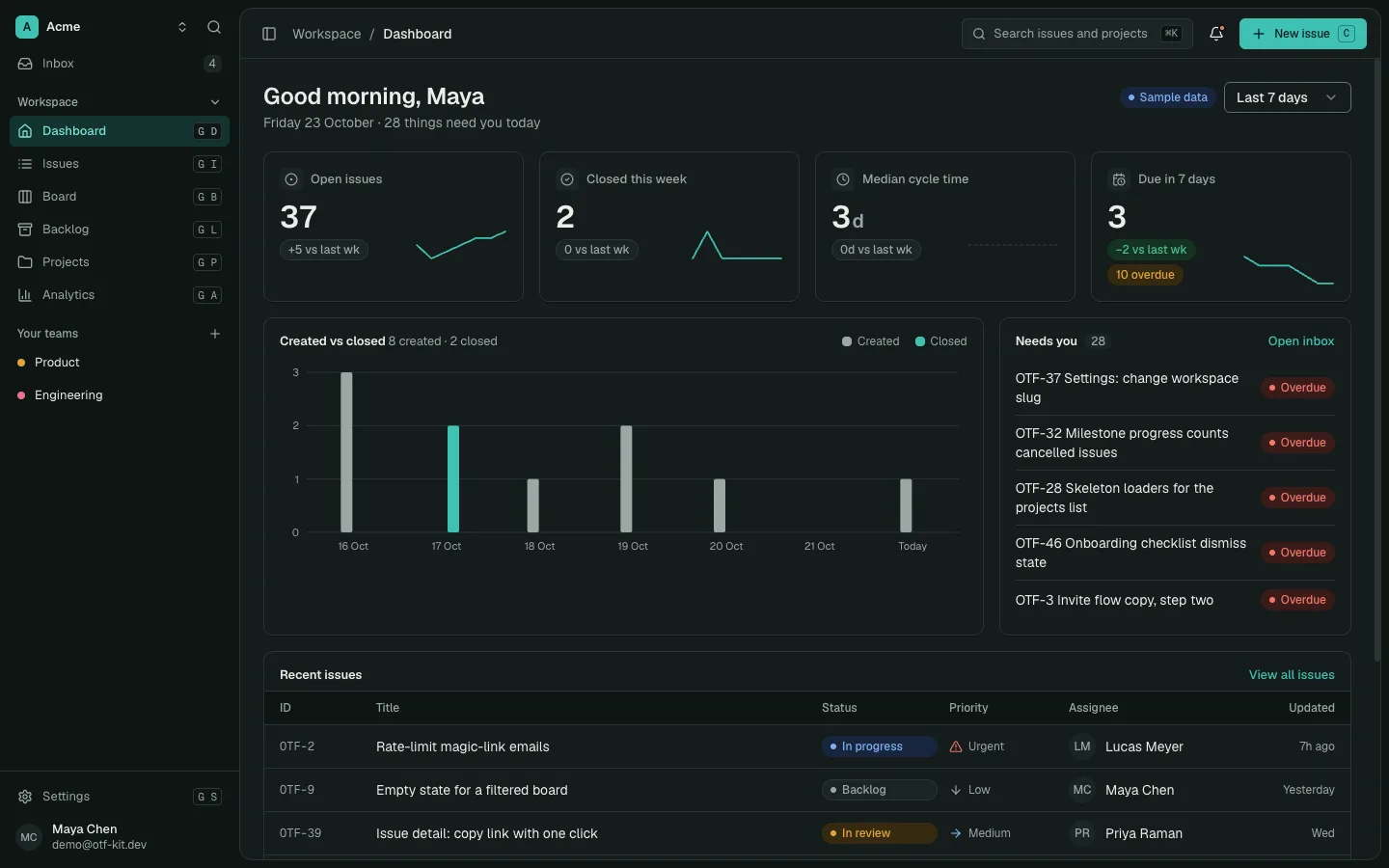
11 production screens. Login and database wired.
The SaaS Dashboard Kit includes login, a database, and a working dashboard. Live demo at saas.otf-kit.dev.
What authentication and authorization features do agent-native identity tools provide?
What does this actually enable for securing AI-generated apps? The core: tested, mature identity primitives — authentication, authorization, permissions, governance — embedded from the moment you start building, not after deployment.
The capability set Ory describes for Agent Security centers on three verbs: authenticate every agent, authorize every tool call, audit what happened. Mapped onto a typical AI-built app, that covers:
- Authentication: signup, login, session management, passwordless flows — the standard Ory identity surface, now reachable from agent workflows.
- Authorization: granular permissioning, role-based access, policy enforcement for both end users and the agents acting on their behalf.
- Auditability: every identity action logged and testable before production, which simplifies audits and regulatory reviews.
- Standards: industry-proven protocols (OAuth2, OIDC), matching what Ory's main platform powers in high-compliance environments.
Instead of re-learning tricky auth flows for every language or scaffolder, unified OAuth2/OIDC workflows mean calls to authenticate a user, issue a session, or check permissions map 1:1 to the proven platform behind the scenes. If you're structuring a repo so agents can work in it safely, our guide to agent-readable repository structure pairs well with this — identity policy and repo structure are the two guardrails that keep agent output production-safe.
Critical detail for compliance: because identity flows can be exercised in dev before they hit production, you build secure-by-default and ship with confidence — no "we'll patch that risk in v2."
How can developers adopt agent-native identity today?
The adoption path follows the shape of Ory's platform: start with the identity primitives locally, iterate, and scale up to production tenants when needed. Concretely:
- Read the product surface. Start at Ory Agent Security to see which harnesses are supported and what the trust framework covers. Verify the supported list matches your stack (Claude Code, Codex, Gemini CLI, or whatever your team runs) before committing.
- Scaffold auth early. Wire signup/login through Ory's SDKs in the first sprint, not the last — the whole point is that identity arrives with the scaffolding, not after it. Ory's docs carry the current integration steps; treat any third-party tutorial (including this post) as orientation, not the manual.
- Define roles before you need them. Add fine-grained permissioning (admin vs member vs agent service accounts) while the policy surface is still small. Our Cursor rules guide shows how to encode these conventions so agents follow them automatically.
- Audit before shipping. Run through the identity flows — login, session expiry, permission denial — as part of your pre-production checklist, the same way you'd test payments.
Note: the code-level install commands and CLI flags for Ory's agent integrations change fast. We deliberately don't reprint them here — follow the official product page and docs for the current steps rather than trusting a blog post's copy-pasted snippet.
Common pitfalls to avoid:
- Assuming the agent's local session equals a production identity — always re-verify against the real tenant before shipping.
- Granting agents broad admin roles for convenience and forgetting to narrow them.
- Skipping the audit trail: if an agent acted with elevated permissions, that should be reviewable after the fact.
What are the benefits of agent-native identity for AI-powered development?
Bringing identity inside the AI agent workspace collapses what used to be weeks of post-hoc "retrofit security" into default-by-design behavior. Key gains:
- Security: strong authentication and authorization are the starting point, not an afterthought.
- Developer velocity: no context switches between code, terminal, and identity dashboards — build and test identity flows as naturally as you write code.
- Compliance and auditability: every identity action is logged and testable before production, simplifying audits and regulatory requirements.
- Governance: API-based role and permission changes are easy to audit and control, not "set once and never revisited."
In pure engineering terms: identity risk is absorbed at the earliest, lowest-effort stage — which is where it actually gets fixed.
Closing
Ory Agent Security isn't just another integration — it's a shift in how authentication and authorization get built into AI-generated software. By making identity a runtime control plane across the coding harnesses teams already use, it lets developers build fast without skipping security, governance, or compliance. As AI changes how code gets shipped, agent-native identity is the missing link for making that code production-worthy from the start — so every app you build with an agent is secure by design, not luck.
Shipping an AI-built app to real users? Start from a kit your agent can actually extend →
Sources
- Ory Agent Security product page — official product name, "control plane" positioning, Claude/Gemini/Codex harness support, authenticate-authorize-audit framing (verified live September 2026).
- Ory homepage — identity platform scope: customer, B2B, and agent identity (verified live September 2026).
Ship the product, not the setup.
- 11 production screens — auth, team, analytics, and settings
- Login and a real database are wired in
- AI configs pre-tuned so your agent extends instead of regenerates
Ship your first screen tonight — free starter in your inbox
The quickstart, the SDK repo and the live kit demos, on this screen and in your inbox.
No spam. Unsubscribe any time.