Xiaomi Mimo Code: open-source terminal agent built for long coding sessions

Xiaomi's MiMo Code is a terminal-native AI coding assistant that reads and writes code, runs shell commands, manages Git, and keeps a persistent memory of your project across sessions. It installs with a single command, connects to mainstream LLM providers, and — according to Xiaomi's launch claims — is built to sustain workflows of up to 200 sequential steps without losing the thread. For developers whose codebases have grown past snippets into multi-phase systems, that long-horizon pitch is the whole story.
This retrofit updates the original release coverage against the one primary source that verifies cleanly today: the public GitHub repository. Everything that could not be re-verified has been trimmed or explicitly hedged.
What Mimo Code actually is
MiMo Code is a terminal-native assistant, not a chat sidebar. Per the repository's own description, it can read and write code, run commands, manage Git, and use a persistent memory system to maintain a deep understanding of your project across sessions while continuously improving itself. It also supports connecting to mainstream LLM provider APIs, so you are not locked to a single model vendor (MiMo Code on GitHub).
That framing matters. Most coding assistants are prompt-response tools: you ask, they answer, context evaporates. MiMo Code positions itself as a durable engineering partner that remembers project state and past decisions across sessions. Whether it fully delivers on that promise depends on your workflow, but the architecture — persistent memory plus terminal-native execution — is aimed at exactly the failure mode developers complain about: assistants that forget what happened sixteen steps ago.
The project is open source and freely available on GitHub, so any developer can audit, fork, or extend it. Check the repository's license file for the exact terms before building on it commercially.
Install and first run
Installation is genuinely one line. On macOS or Linux:
curl -fsSL https://mimo.xiaomi.com/install | bashOn Windows PowerShell:
powershell -ep Bypass -c "irm https://mimo.xiaomi.com/install.ps1 | iex"Or via npm on any platform:
npm install -g @mimo-ai/cliThen run mimo. The first launch walks you through configuration automatically, with options including Xiaomi's own platform via OAuth login, Codex via OpenAI OAuth, one-step migration importing existing Claude Code authentication, catalog providers by API key or OAuth, and any custom OpenAI-compatible endpoint configured in the built-in interface (MiMo Code on GitHub).
Two practical notes from the repo docs: MiMo Code does not support the built-in macOS Terminal app — use iTerm2 or the VS Code integrated terminal instead — and on WSL, install xsel if clipboard copying produces garbled text. For remote work over SSH, you can run mimo serve on the remote host and attach locally over an SSH port forward. These are the unglamorous details that determine whether a tool survives first contact with a real dev machine, and the repo documents them well.
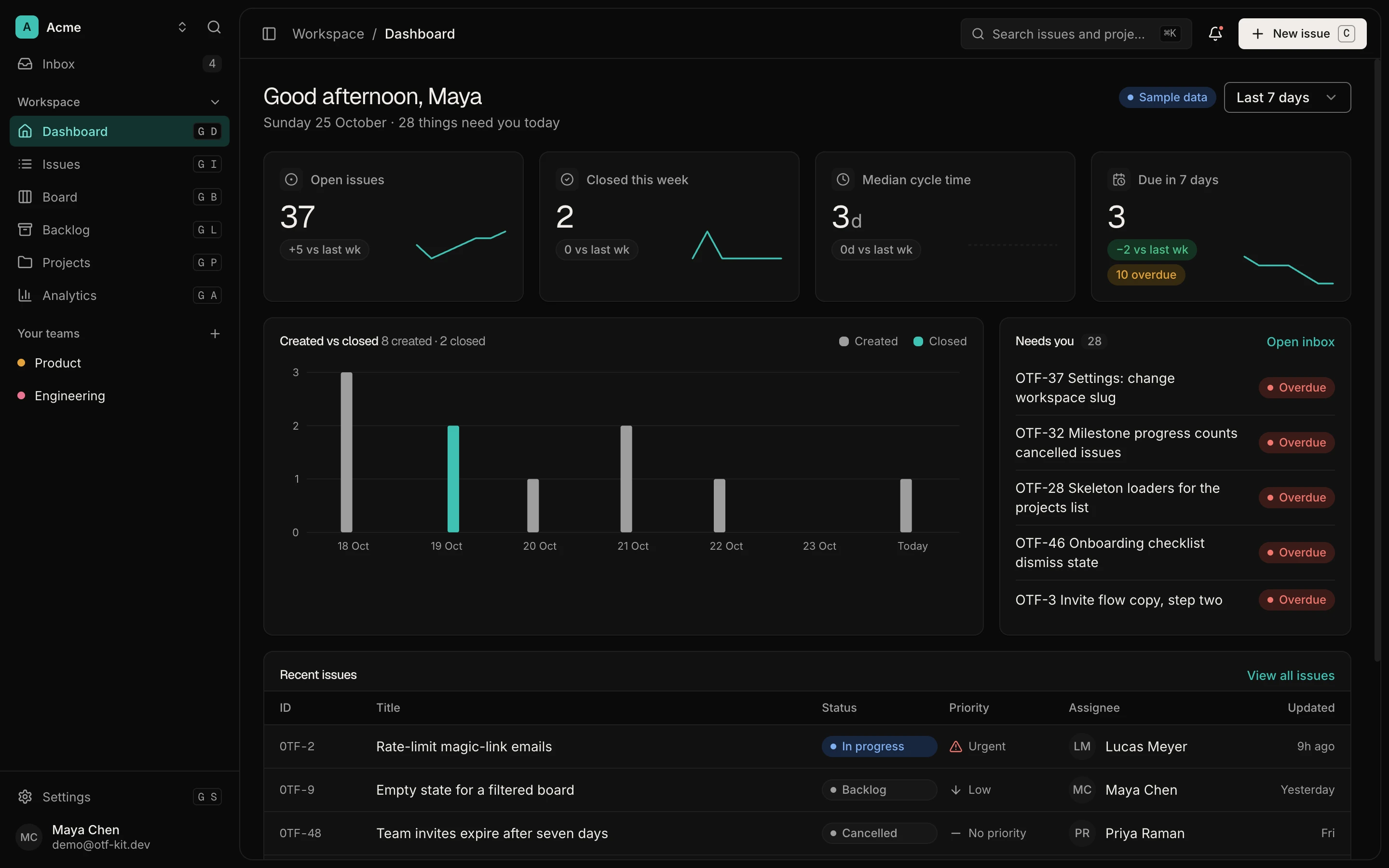
11 production screens. Login and database wired.
The SaaS Dashboard Kit includes login, a database, and a working dashboard. Live demo at saas.otf-kit.dev.
Long-horizon workflows are the real test
The headline claim at launch was that MiMo Code handles ultra-long software workflows — tasks requiring up to 200 sequential steps — and outperforms Claude Code in those scenarios. Treat that number with the caution it deserves: it rests on Xiaomi's own internal evaluations, not an independently reproduced benchmark, and the company's long-horizon blog post no longer resolves at its published URL. The honest reading is that Xiaomi designed for sustained instruction recall and stepwise problem-solving, and reports good results on its own evaluations.
Even hedged, the direction is right. The binding constraint on agentic coding is not single-shot code quality — frontier models all write decent functions — it is context retention over hours-long, multi-phase builds: feature work plus debugging plus cross-system modifications, with decisions compounding. A terminal-native agent with persistent memory and Git access is structurally better suited to that shape of work than a completion popup. If you evaluate MiMo Code, evaluate it there: give it a genuine multi-step task, not a LeetCode prompt.
For teams wiring agents into real repos, structure matters as much as the model. An agent-readable repository structure — clear conventions, documented boundaries, machine-parseable context — is what lets any long-horizon agent, MiMo Code included, stay oriented past step fifty. And Cursor rules for Next.js show the same principle from the rules-file side: the agent is only as durable as the context you give it.
How to think about it against Claude Code
The launch narrative framed MiMo Code as outperforming Claude Code on long-horizon tasks. Without a live vendor benchmark page to cite, keep that as vendor positioning, not settled fact. What is verifiable is the differentiation strategy: open source versus proprietary, multi-provider versus single-vendor, terminal-native with persistent memory versus session-scoped assistance. Those are real architectural choices you can evaluate hands-on in an afternoon.
The pragmatic move is a bake-off on your own codebase: same multi-step task, both tools, score on completion without intervention. Vendor benchmarks rarely survive contact with your monorepo anyway. If you run structured agent sessions, Cursor prompts for agent sessions offers patterns for keeping long runs on track regardless of which agent you drive.
Limits and open questions worth tracking
No honest retrofit ends at the marketing claims. First, the performance story is single-source: until Xiaomi or a third party publishes reproducible long-horizon evaluations, the 200-step figure is a design goal with vendor-reported backing, not a measured lead. Second, persistent memory is a double-edged tool — memory that compounds good decisions also compounds bad ones, so check what controls exist for inspecting, editing, or wiping what the agent remembers before pointing it at production repos. Third, provider flexibility shifts the cost and privacy questions onto you: routing through third-party APIs means your code transits their systems, so match the provider to your compliance posture rather than defaulting to whatever is cheapest. None of these are disqualifiers. They are the standard diligence list for any agent you grant shell access, and MiMo Code's open-source nature makes that diligence easier than with a black box — you can read the code that reads your code.
Where it fits in a shipping stack
A coding agent writes code; shipping still needs everything around it — auth, payments, deployments, error tracking. That is the gap OTF kits close: a full-stack foundation your agent can build on instead of scaffolding from zero. Browse the production-ready starting points at OTF templates and pair them with whichever agent wins your bake-off.
Sources
- MiMo Code on GitHub — terminal-native assistant description, install commands, provider options, platform notes; verified live September 2026.
- Xiaomi's long-horizon write-up (
mimo.xiaomi.com/en/blog/mimo-code-long-horizon) — returned 404 on re-verification September 2026; benchmark specifics in this article are therefore attributed as vendor launch claims, not independently verified results.
Ship the product, not the setup.
- 11 production screens — auth, team, analytics, and settings
- Login and a real database are wired in
- AI configs pre-tuned so your agent extends instead of regenerates
Ship your first screen tonight — free starter in your inbox
The quickstart, the SDK repo and the live kit demos, on this screen and in your inbox.
No spam. Unsubscribe any time.