
Claude Opus 4.8 rewards codebases that explain themselves to coding agents

Claude Opus 4.8 is a meaningful release for builders using coding agents on real repositories. Anthropic says the model is more effective at agentic tasks, keeps the same regular-use price as Opus 4.7, and is more likely to flag uncertainty instead of making unsupported claims. That last change deserves more attention than another benchmark headline because it changes what the model reveals about your codebase.
A coding agent that asks, “Which of these two patterns is canonical?” is not necessarily slowing you down. It may be reporting that the repository has no answer. On a codebase with written conventions, tests, and one clear path for common work, that honesty gives the agent a better runway. On an exported or heavily hand-edited project, it turns hidden ambiguity into an explicit engineering task.
What changed in Claude Opus 4.8?
The direct answer is judgment. Anthropic reports that early testers found Opus 4.8 more reliable in agentic work, with better judgment about when to ask questions, catch mistakes, and push back on an unsound plan. The company also says its evaluations found the model around four times less likely than its predecessor to allow flaws in generated code to pass unremarked.
Those are Anthropic’s claims, so read the official Claude Opus 4.8 announcement for the methodology and surrounding results. The engineering implication is narrower and more useful: the agent may expose uncertainty that a more agreeable model would hide.
That is a capability improvement, not a guarantee that every warning is correct. Treat the warning as a high-value review signal. Inspect the files, confirm the convention, and write down the answer if the repository is missing one.
Why an honest agent makes repository quality visible
Imagine a feature request in a repository with two authentication flows, three data-fetching patterns, and no rule saying which one new work should use. The agent has enough examples to produce plausible code, but not enough evidence to choose safely.
A model optimized to keep moving may select the nearest-looking example. The diff can be syntactically correct and still be wrong for the product. The failure appears later, when a different screen expects the other session shape or a migration updates only one of the three paths.
Opus 4.8’s reported behavior creates a better checkpoint:
I found two authentication patterns:
- src/auth/session.ts reads the server session
- src/features/account/use-session.ts reads a client cache

I cannot infer which is canonical for new screens. Which should I use?
That question has a cost, but it is a bounded cost. You can answer it once, encode the decision in the repository, and make the next task cheaper. The old failure mode charged interest: every confident guess widened the inconsistency.
The point is not to make the agent timid. The point is to make uncertainty observable before a large change spreads it.
11 production screens. Login and database wired.
The SaaS Dashboard Kit includes login, a database, and a working dashboard. Live demo at saas.otf-kit.dev.
What should you write down before delegating work?
Start with the answers an agent repeatedly has to infer. Keep them close to the code and make them testable.
A useful repository guide should state:
- The command that installs dependencies and starts the application.
- The command that runs the type checker and tests.
- The canonical authentication and authorization path.
- The location and naming rule for a new feature.
- The database migration and seed workflow.
- Which files may be changed by an automated task.
- What evidence is required before calling a task complete.
For a Claude Code repository, that guide is commonly placed in CLAUDE.md. The filename is not the important part; the answers are. A short document with commands that actually work beats a long document that describes an older project.
Use acceptance checks rather than wishes:
## Add a billing settings screen

- Reuse the existing account layout and server-side session check.
- Add loading, empty, error, and success states.
- Run `pnpm typecheck` and the focused test command.
- Include the command output or a screenshot in the handoff.
- Do not change authentication or billing provider configuration.
The exact commands must match your repository. Do not copy this block unchanged into a project that uses different scripts. The value is the contract: path, boundary, verification, and evidence.
How do dynamic workflows change the risk?
Anthropic describes dynamic workflows as a research-preview feature in Claude Code that can plan larger tasks and run hundreds of parallel subagents in one session, then verify outputs. The announcement gives codebase-scale migrations across hundreds of thousands of lines as an example.
Parallel work increases the value of consistency. If every worker receives the same clear target pattern, parallelism can reduce elapsed time. If the repository contains several undocumented patterns, parallel workers can multiply the ambiguity:
Worker A -> feature pattern 1 -> locally valid change
Worker B -> feature pattern 2 -> locally valid change
Worker C -> feature pattern 3 -> locally valid change
                       |
                 inconsistent merge
Use a real diagram for that relationship in documentation rather than relying on a wall of prose:
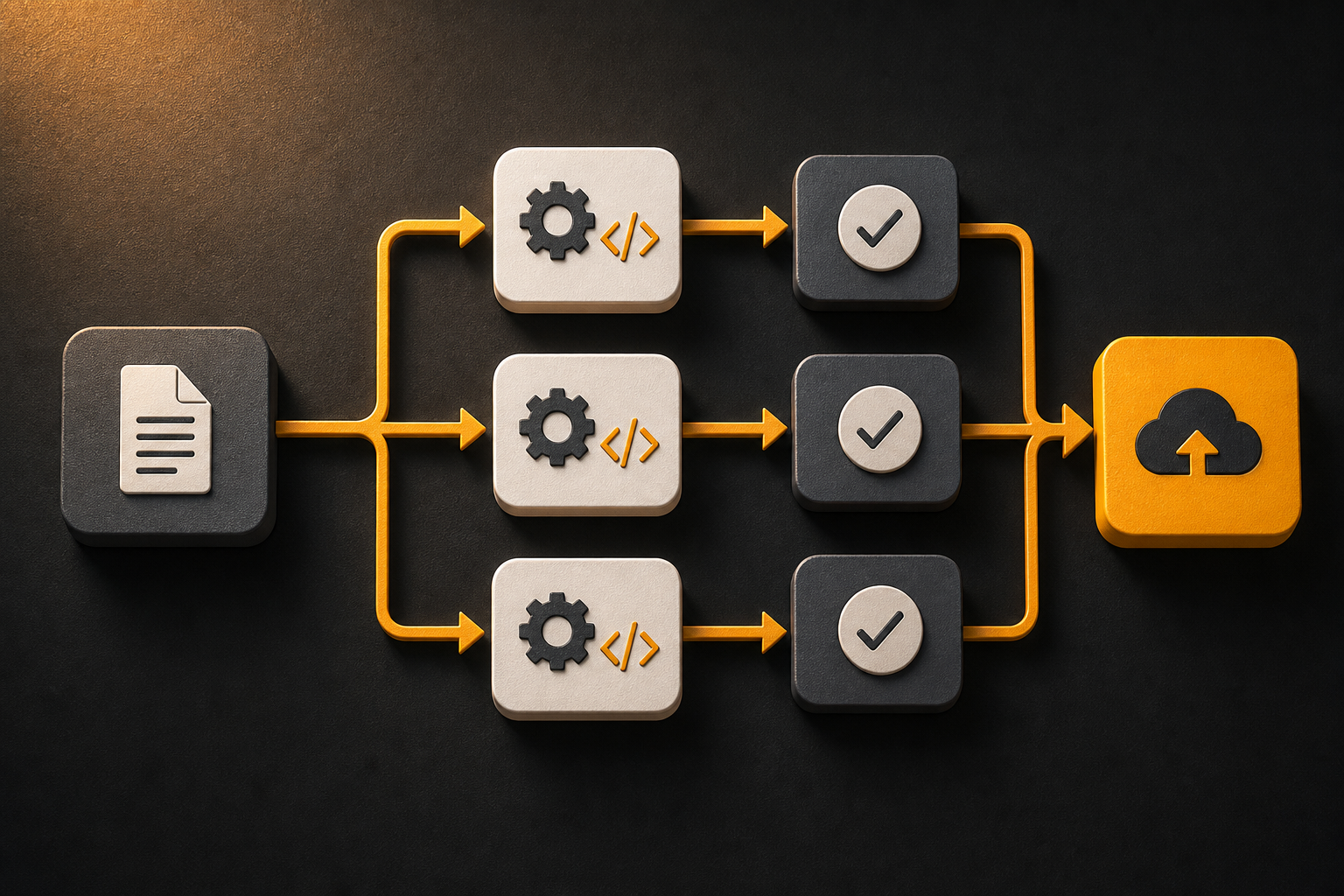
.
The safeguard is not “trust the model more.” It is to narrow the task, define the target pattern, and make the existing test suite a merge condition. Ask the agent to inspect before editing. Ask it to list conflicts it cannot resolve. Require a small first batch when the migration crosses unfamiliar areas.
If the model flags an inconsistency, pause the fan-out. Resolve the repository decision first. Otherwise, you are paying to repeat the same unanswered question in parallel.
How do you use Opus 4.8 without wasting the honesty signal?
Give it a staged prompt. The first turn should produce an inventory and a plan, not a repository-wide diff.
Inspect the repository for the requested change. Before editing:
1. Find the current pattern used by three comparable features.
2. Report any conflicting patterns and cite their file paths.
3. Identify the tests and commands that verify this change.
4. Propose the smallest implementation plan.
5. Stop and ask if a canonical choice is missing.
Then answer questions in the repository guide, not only in chat. A chat answer can unblock one session; a committed convention helps the next agent and the next teammate.
For a long-running task, divide the work into checkpoints:
- Inventory the existing patterns.
- Choose or document the canonical pattern.
- Implement one representative change.
- Run focused checks.
- Expand the change only after the representative diff is accepted.
- Run the full verification suite before merge.
Anthropic also says Opus 4.8 defaults to high effort, with extra and max options for harder work, and that the regular API price is $5 per million input tokens and $25 per million output tokens. Those are current release details, not a reason to hand it an unconstrained task. A smaller context and a clear stop condition can produce better evidence than a huge prompt.
What does this mean for AI-generated projects?
The lesson is not that an exported project is doomed. It is that generated code still needs an owner’s decisions. An agent can inspect a repository, but it cannot infer product intent from duplicated examples with certainty.
Before asking for a new production feature, create a short “how this project works” layer. Include the one path for auth, data access, errors, testing, and deployment. Remove stale instructions when the implementation changes. Add a regression test when a convention matters enough to protect.
This is why background jobs for AI features treat state transitions and retries as explicit application behavior rather than implied model behavior. The same principle applies here: if a rule matters, make it visible in code, tests, or a repository document.
Builders who use Cursor pricing and usage guidance or Claude Code are choosing an agent, not outsourcing architectural ownership. The model can be a faster collaborator when the repository gives it stable boundaries. OTF’s full-stack app templates take the complementary approach of starting with owned application code, documented conventions, AI-tool configs, and deployment scripts, so the agent extends a project instead of reconstructing its shape from scattered examples.
Claude Opus 4.8’s honesty is useful precisely because it makes ambiguity harder to ignore. Let it ask the uncomfortable question, answer that question in the repository, and use tests to check that the answer survives the next change. The model gets better at judgment; your codebase still has to supply the decisions.
Sources
Originally published at otf-kit.dev — full-stack app templates for web and mobile. See the templates →
Ship the product, not the setup.
- 11 production screens — auth, team, analytics, and settings
- Login and a real database are wired in
- AI configs pre-tuned so your agent extends instead of regenerates