
Meta's AI Chip Production & Cursor's $50B Valuation: Top Tech News

Custom AI silicon is one of the most expensive bets a tech company can make. Meta is taking that bet with Iris, a chip it plans to put into production this September. The stated goal is direct: power Meta's expanding AI infrastructure and reduce its reliance on Nvidia and AMD. That's not a marketing announcement — that's a multi-billion-dollar commitment that, if it lands, reshapes the cost curve for every AI product Meta ships. Worth taking seriously.
What we know about Iris — and what we don't
The source today is a single line in the morning tech roundup: Meta will begin producing its custom AI chip, codenamed Iris, in September. That's it. No specs, no process node, no benchmarks, no capacity figures. What is stated is the intent — power expanding AI infrastructure, reduce reliance on Nvidia and AMD — and the timing.
That's still more signal than noise. Naming a chip, picking a production month, and going public with the plan means fab time is booked, silicon is taped out, and Meta has signed off on the build. The announcement is downstream of the engineering work, not upstream of it.
What we don't know, and shouldn't pretend to:
| Question | Status |
|---|---|
| Process node | Not disclosed |
| Peak FLOPS / memory bandwidth | Not disclosed |
| Training vs inference focus | Not disclosed |
| Production volume | Not disclosed |
| Per-unit cost vs H100/B200 | Not disclosed |
The honest read: Iris exists, it's real, and the public benchmarks land when Meta decides to publish them. Every specific number you'll see in coverage between now and then is analyst speculation dressed as fact.
Why custom silicon is the strategic play
The article gives the reason in one phrase — reduce reliance on Nvidia and AMD. That phrase hides four pressures any hyperscaler at Meta's scale has been feeling for two years:
- Supply. Nvidia allocation has been rationed by compute, not by budget. Owning the design means owning the priority.
- Cost. Margins on inference at hyperscale are tight. Every dollar shaved off per-token cost compounds across billions of calls.
- Tuning. A general-purpose GPU is built for everyone's workloads. A custom ASIC is built for one company's routing, batching, and serving patterns. The win is in the specifics.
- Roadmap control. Nvidia's roadmap is Nvidia's. Meta's roadmap is Meta's. For a company running its own foundation models, that's the only roadmap that matters.
None of those are confirmed in the source — they're the obvious pressures a chip of this kind exists to relieve. Frame them as the why-it-makes-sense, not as Meta's stated rationale.
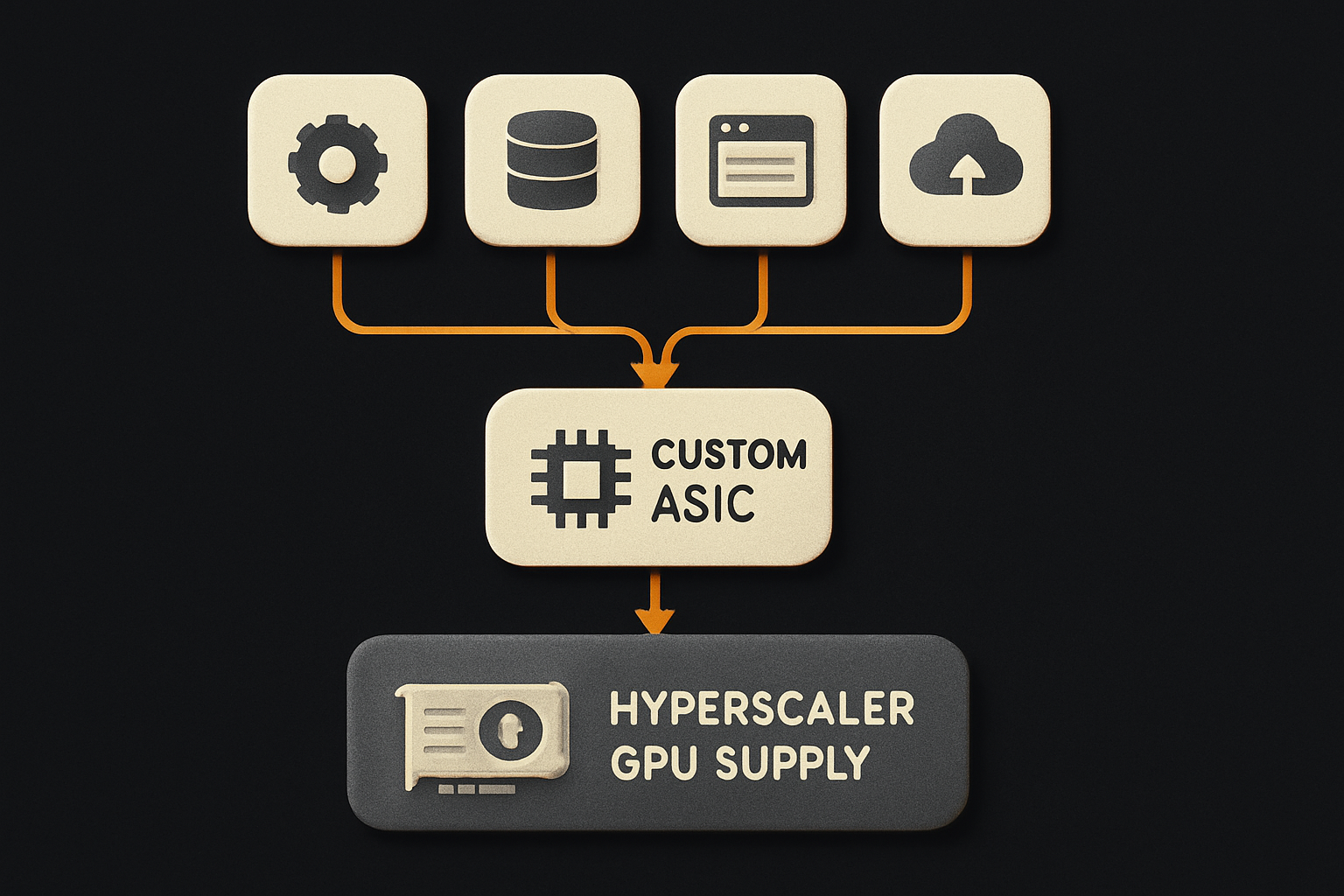
11 production screens. Login, database, payments — all wired.
The SaaS Dashboard Kit ships everything already connected. Nothing to set up. Live demo at saas.otf-kit.dev.
What Iris means for builders — today
Direct access: zero. Iris is internal silicon for Meta's data centers. There is no developer program, no cloud SKU, no waitlist. If your product runs on Meta-hosted AI, you're not getting Iris-accelerated anything in September — you're getting whatever Meta routes you to, on whatever chip is cheapest that day.
Indirect access, which is the real story, comes through two channels:
- Cheaper inference at the API layer. If Iris lands and Meta shifts even a meaningful slice of internal inference to in-house silicon, the public Meta-hosted AI pricing has room to fall. The first observable signal will be a price change on the public endpoints, not a benchmark.
- Faster model rollout. Custom silicon tuned for a specific model architecture means shorter feedback loops between training a new model revision and serving it. Expect more frequent updates from Meta, not fewer.
The practical move for a builder today is to keep your inference layer model-agnostic so the day Iris-priced capacity shows up, you can route to it without a rewrite. Concretely:
// keep the model selection at the edge of your stack, not the center
const client = new OpenAI({
  baseURL: process.env.INFERENCE_BASE_URL, // swap providers without touching call sites
  apiKey: process.env.INFERENCE_API_KEY,
});

const completion = await client.chat.completions.create({
  model: process.env.MODEL_ID ?? "meta-llama/llama-3.1-70b-instruct",
  messages,
});
One base URL, one model ID, both env vars. No code change when the price drops or the chip underneath rotates.
The other signal in the same news cycle: Cursor at $50B
Same morning, same roundup: AI coding startup Cursor closed fresh funding at a $50B valuation. The reason given is demand for AI-powered software development tools continuing to grow. That's the second half of the same story.
Two companies just got explicit market signals on the same day:
- Meta: vertical integration down to the silicon. Own the chips, own the cost.
- Cursor: vertical integration up to the editor. Own the surface where code gets written.
Both bets assume the same thing — AI is now the load-bearing layer of the software stack, and whoever controls more of that layer wins the margin. For builders, that resolves a question that's been open for two years: yes, AI-assisted workflows are the default in three years. The $50B is the market's answer, not yours.
The part that doesn't change when the chip does
Here's where OTF earns its keep, and it's not because Iris is risky or Cursor is overvalued. Both bets will probably land, and both will move underneath whatever you ship this quarter.
The layer they don't touch is the surface where your users actually live: the cross-platform UI. When Meta swaps H100s for Iris, your model calls get cheaper. When Cursor ships a new agent loop, your editor gets faster. Neither change moves a pixel on the screen your user is looking at.
That's the durable layer. One component definition, web and mobile — the same component on iOS, Android, and the browser — no fork, no rewrite when the underlying tool changes. The cost curve and the editor curve both run under the UI layer, and the UI layer is the only one that has to render correctly in three places at once.
You don't pick between Meta's silicon and Cursor's editor. You build on top of both, and you put the cross-platform abstraction where the churn isn't.
Other threads worth knowing
The article also flags two stories outside the AI-coding lane:
- India's AI-driven hiring trends. The demand signal is now visible in hiring data, not just funding rounds. Worth a five-minute skim if you're staffing or hiring.
- Pakistan's crypto regulation. Regulatory pace is the variable here, not the tech. The interesting question is whether the framework lands before or after the next market cycle.
Neither is actionable today. Both are worth tracking if regional tech policy is on your radar.
What to do this week
- Pin the September production date. The first real signal of Iris health will be whether Meta's own AI products feel faster or cheaper by Q4. Set a reminder for October.
- Make your inference layer swappable. One base URL, one model ID, both env vars. The provider underneath is the most volatile part of your stack right now.
- Watch the Cursor releases. $50B buys a lot of product velocity. Whatever they ship next quarter will set the bar for AI-coding UX.
- Stop optimizing for today's chip and today's editor. Both will rotate inside 18 months. The cross-platform surface is the part you actually own.
The chip underneath your model and the editor in front of your code both change underneath you. What you ship to the user is the only thing that has to keep working through every one of those rotations. Build that layer once, build it to last.
Ship the product, not the setup.
- 11 production screens — auth, billing, team, analytics, settings
- Real database, payments, and login — all wired on day 1
- AI configs pre-tuned so your agent extends instead of regenerates