
Grok 4.5: SpaceXAI's Leap Forward in AI with Cursor

Grok 4.5 shipped on Wednesday, and the most interesting thing about it is not the speed. It's that the model was built with an AI coding tool — Cursor, the same IDE-shaped assistant you'd use to write a React component on a Tuesday afternoon. SpaceXAI (formerly xAI) used Cursor to build a frontier model. That is the actual story.
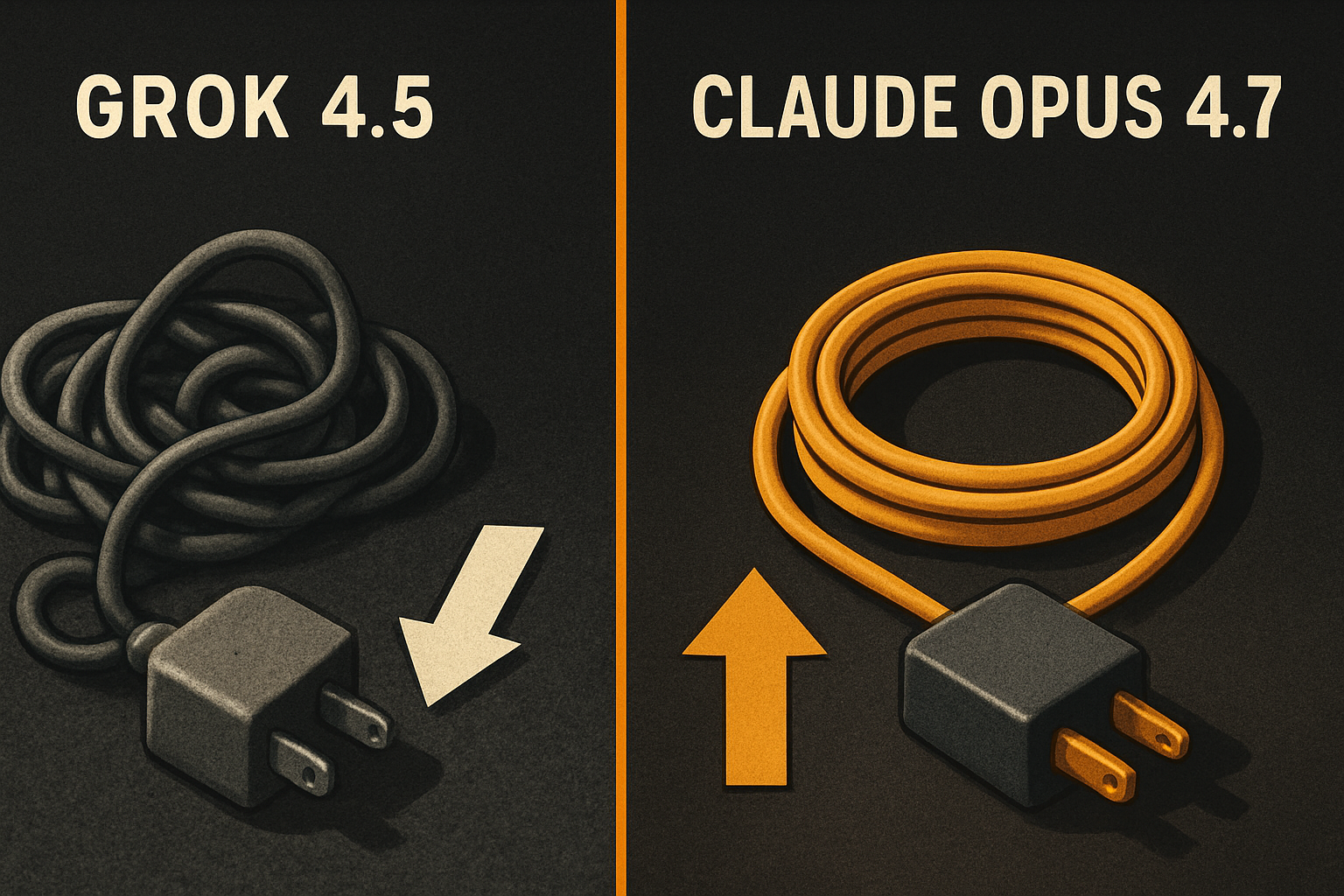
The second most interesting thing is the comparison the company is making. Elon Musk says Grok 4.5 matches Anthropic's Claude Opus 4.7 and is "much faster" doing it. "The combination of capability, higher speed, and lower cost is what makes it competitive," he said, in the announcement covered by The Hans India. That is a vendor claim. We will get to what is verified and what is not.
This post is the comparison you actually wanted: Grok 4.5 vs Claude Opus 4.7 — what shipped, what the launch demonstrated, what is unverified, and the part of your stack that should not have to change when you swap one model for the other.
The meta-lesson buried in the launch
Grok 4.5 is the first joint model from SpaceXAI and Cursor. That sentence does most of the work.
Cursor is a coding tool. It edits files, runs commands, ships PRs. SpaceXAI used it to train and ship a frontier language model. The same class of tool that builds your SaaS dashboard also built a model that is now positioning itself against Claude Opus 4.7.
Weeks before the launch, SpaceX formally agreed to acquire Cursor in a deal that valued the startup at $60 billion. The deal and the launch are not coincidences. The point of the acquisition is exactly this: a coding tool that is good enough to build the model is good enough to be the model company's primary surface. Cursor becomes both the assembly line and the product.
For the rest of us, the practical question is smaller. If an AI tool can be used to build an AI model, the tools have crossed a line. You can now reasonably use the same category of tool to build the next thing that ships, regardless of which model sits underneath.
What Grok 4.5 actually is
Per SpaceXAI's Wednesday launch post, Grok 4.5 is designed to "handle complex, long-running tasks" — primarily in software engineering, with extensions into legal and financial services. The same surface area Claude Opus 4.7 advertises.
Concretely, the launch demonstrated:
- A solar system simulation built with Three.js from a single prompt, with time controls and "realistic movement"
- Complex Excel models built from web searches with multi-sheet formulas
- Notes added "for future reference" alongside the spreadsheet
- PowerPoint diagram generation
- Drafting (the announcement was truncated at this point)
Grok 4.5 is also now the default model for Grok Build, the company's app-generation surface. That matters for the comparison: the "default" seat in a build pipeline is the seat Claude Opus 4.7 holds in Anthropic's tooling and the seat ChatGPT holds in OpenAI's. Whichever model sits there defines what gets shipped by default — and which one is named in the README of the next SaaS product.
11 production screens. Login, database, payments — all wired.
The SaaS Dashboard Kit ships everything already connected. Nothing to set up. Live demo at saas.otf-kit.dev.
The Claude Opus 4.7 comparison, taken seriously
The Claude Opus 4.7 counterpart is Anthropic's flagship programming model — the model SpaceXAI is explicitly positioning against in this launch. The article frames the same turf: programming, financial services, legal services. Anthropic has been advancing its coding tools; SpaceXAI had been behind on that exact surface, per the announcement.
Grok 4.5 is positioning itself as catching up on the same surface. The launch showcased the same areas — software engineering, legal, financial. The framing in the announcement is that Grok 4.5 matches Claude Opus 4.7 on capability while moving faster and costing less.
The honest read: capability parity is a vendor claim. "Much faster" is a vendor claim. We do not yet have independent benchmarks from a third party comparing Grok 4.5 to Claude Opus 4.7 on the same tasks. Treat the launch as a credible signal that SpaceXAI is closer than it was, not as a settled ranking.
What is verified, what is not
| Claim | Source | Status |
|---|---|---|
| Built with Cursor | SpaceXAI launch post | Verified (vendor) |
| First joint SpaceXAI + Cursor model | SpaceXAI launch post | Verified |
| Cursor acquisition valued at $60B | The Hans India | Listed, not final — acquisition terms can change |
| Matches Claude Opus 4.7 on capability | Musk, vendor statement | Vendor claim, no independent benchmark |
| "Much faster" than Claude Opus 4.7 | Musk, vendor statement | Vendor claim, no independent benchmark |
| Lower cost than Claude Opus 4.7 | Musk, vendor statement | Vendor claim, no published rate card comparison |
The pattern matters. The launch event was a vendor demo, not a bake-off. If "much faster" turns out to mean 10% on a code-gen task, the headline does most of the work. If it means 2× on long-context agentic loops, the headline is underselling. Until a third party publishes a side-by-side, this is a claim to test, not a fact to repeat.
How to use Grok 4.5 today
The launch wasn't just an announcement — Grok 4.5 is now the default model in Grok Build. If you want to try it against a real task, the shortest path is the build surface itself.
If you have a Cursor subscription, the integration is the most direct surface — Cursor was the tool that built the model, and the joint-model story is the new default for code-related work. The model picker should expose it.
If you want to call it from your own code, OpenRouter is the canonical model-agnostic surface for new releases in 2026. The exact id is the one OpenRouter lists at /api/v1/models once Grok 4.5 is published there — it follows the vendor/name convention. Check the live endpoint, do not hardcode.
# OpenRouter is the fastest path to a new model in 2026.
# Confirm the exact model id at
curl  \
  -H "Authorization: Bearer $OPENROUTER_API_KEY" \
  -H "Content-Type: application/json" \
  -d '{
    "model": "xai/grok-4.5",
    "messages": [
      {"role": "user", "content": "Build a Three.js solar system with time controls and realistic orbital movement."}
    ]
  }'
The Three.js example is a useful first prompt because it is exactly what the launch demoed. If the model can land a non-trivial interactive scene from one sentence, the speed claim has a concrete surface. If it cannot, you will know in one turn.
For the agentic, multi-step work the launch emphasised — Excel models with web searches, multi-sheet formulas, notes "for future reference" — point the model at a real spreadsheet task. The signal is in whether it produces a usable workbook on the first shot, not in the latency number.
The part that doesn't change when the model does
The model churn is real. Grok 4.5 ships today. Claude Opus 4.7 shipped weeks ago. The next generation of each will ship in months, not years. The benchmark that mattered in February is the benchmark you will skip in November. If your stack is welded to the model — if "we use Claude for code" is in the README and a different vendor is in the procurement queue — you re-do the work every cycle.
The piece that does not change is the part the user touches. The component library. The interaction model. The way a list behaves on web, iOS, and Android. The cross-platform parity. The accessibility tree. The same card, the same form, the same modal — present and correct on every surface, one API, not three.
That is the durable layer. It does not care which model wrote the code that produced it. It does not need to be re-benchmarked when the speed claim turns out to be 10% or 2×. It does not have a model field in its package.json.
Grok 4.5 is a credible Cursor-built competitor to Claude Opus 4.7. Use it. Test the speed claim on your actual workloads. Switch to Claude when Claude wins your benchmark, and back again when the next Grok ships. The model is a tool. The model churns. The layer underneath — the one that ships pixels and components to real users — should be the part you stop rewriting.
What to watch
Three signals over the next few weeks will tell you whether the launch was real:
- Independent benchmark results comparing Grok 4.5 to Claude Opus 4.7 on long-context agentic tasks. The vendor claim is the floor, not the ceiling.
- A published rate card for Grok 4.5 alongside Claude Opus 4.7. "Lower cost" is meaningless without numbers.
- Whether the Cursor integration deepens into a default surface for SpaceXAI work, or stays a checkbox. A $60B acquisition implies more than a checkbox.
For now: Grok 4.5 is a real model with a real speed claim, and the only thing that decides whether the claim matters to you is the benchmark on your workload. The tool is exciting. The durable layer is what you build on top of it.
Ship the product, not the setup.
- 11 production screens — auth, billing, team, analytics, settings
- Real database, payments, and login — all wired on day 1
- AI configs pre-tuned so your agent extends instead of regenerates