
Tailwind UI to Tailwind Plus: run the license and paste gate before your next block

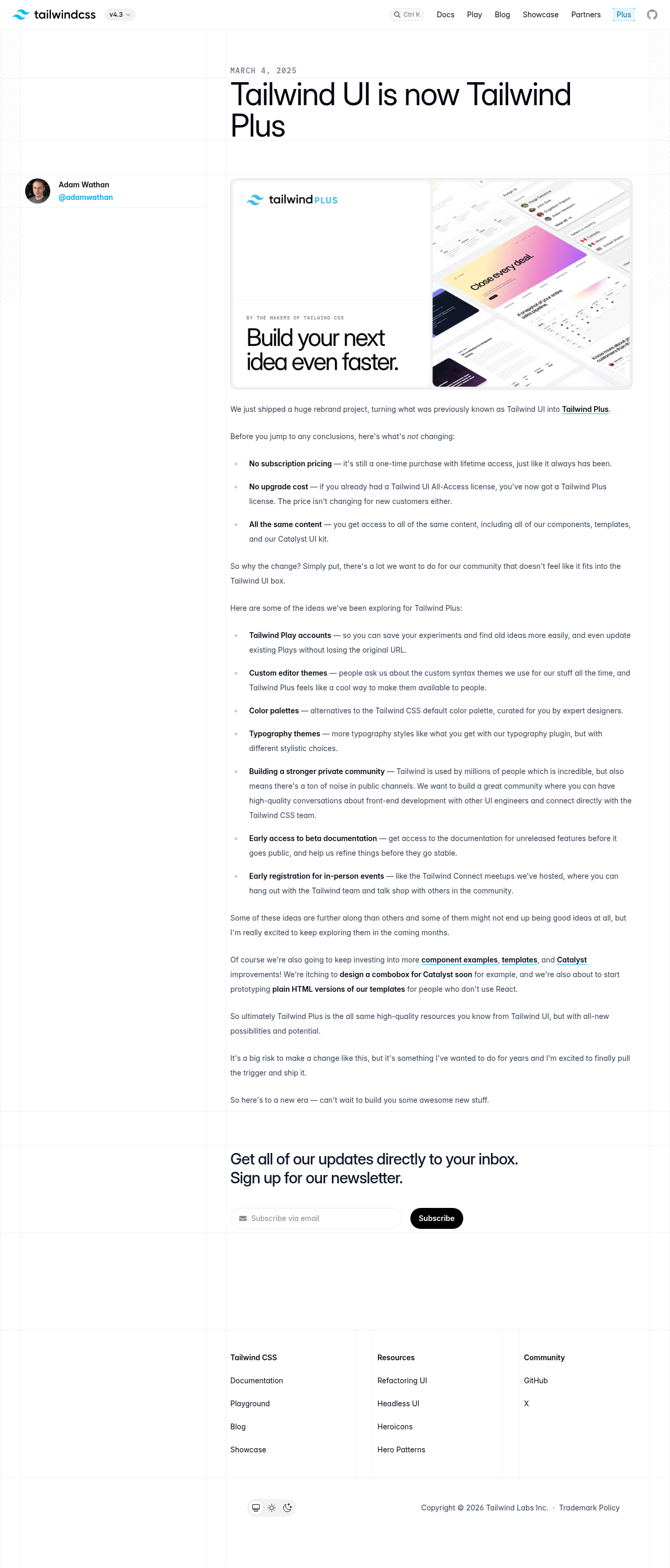
Tailwind UI did not disappear — Tailwind Labs rebranded it to Tailwind Plus on 4 March 2025. Same one-time purchase, same lifetime access, same component packages, templates, and Catalyst. If your team still says "Tailwind UI" in tickets, you are probably talking about Tailwind Plus. The risk is not the rename. The risk is pasting from a stale mental model of the catalog.
Run a license and paste gate before the next marketing block lands in your product repo.
What the rebrand actually changed
Adam Wathan's post is explicit about continuity:
- No subscription pricing
- No upgrade cost for existing All-Access licenses
- The same content — components, templates, and Catalyst
What changed is the product surface and the future roadmap: Tailwind Plus is the login and catalog home at tailwindcss.com/plus, with room for community and tooling experiments that did not fit the old Tailwind UI box. For builders, that means your bookmark, download path, and agent instructions should point at Plus — not a retired name in a README from 2024.
The license gate (15 minutes)
Before anyone pastes another pricing section, verify ownership and access:
- Confirm the license is All-Access / Tailwind Plus (or the specific pack you paid for) — not a leaked zip from a teammate's laptop.
- Sign into Tailwind Plus with the account that owns the license.
- Download or open the current catalog from that surface — do not reuse a year-old mirror folder named
tailwind-ui-export. - Record in the repo which flavor you standardize on (React, Vue, or HTML) and which package version / download date agents may cite.
- Update
CLAUDE.md/.cursorrulesso agents stop saying "grab Tailwind UI" and start saying "paste only from our locked Plus wrappers."
If step 1–3 fail, stop. A beautiful block from an unverified zip is a licensing and drift problem, not a design win.

11 production screens. Login, database, payments — all wired.
The SaaS Dashboard Kit ships everything already connected. Nothing to set up. Live demo at saas.otf-kit.dev.
The paste gate (what "current" means in the repo)
A current license still produces stale UI if every feature team pastes raw examples into feature folders. The paste gate is a repo rule, not a taste debate.
# 1) Find raw marketing pastes that never got wrapped
rg -n "from '@/components/(button|input|fieldset)'|pricing-section|hero-section" apps/ web/ src/ \
  --glob '!**/components/ui/**' --glob '!**/components/marketing/**' | head

# 2) Confirm agent rules name the Plus wrappers, not the old product name
rg -n "Tailwind UI|Tailwind Plus|Catalyst" CLAUDE.md .cursorrules .cursor/rules 2>/dev/null | head

# 3) One sentence for the PR
# "Paste source = Tailwind Plus <date>; wrappers live under components/marketing; no raw catalog paths in features."
Pass criteria:
- New UI enters through thin wrappers you own, not through a fifth copy of the same hero.
- Agents are pointed at those wrappers.
- Catalyst (if you use it) is imported as your app-chrome starting point, then customized in-tree — matching Catalyst's own "disappearing UI kit" model from the Catalyst introduction: copy source into the project, then forget it was not yours.
Fail criteria:
- Three pricing sections with slightly different class soups.
- READMEs that still say Tailwind UI with a dead download link.
- Agents inventing button APIs because nothing in the repo is canonical.
Catalyst inside the same license
Catalyst is included with the Plus / All-Access purchase. The intro post positions it as a batteries-included application UI kit: real React components with composable APIs, meant to be copied into your project and owned. Headless UI improvements ship underneath for menus, listboxes, and form wiring.
That matters for the paste gate:
- Marketing blocks are examples you adapt once.
- Catalyst components are a starting architecture you keep in
components/and evolve. - Mixing both without rules is how you get a marketing hero API fighting an app
ButtonAPI in the same PR.
If your backlog is mostly signed-in product chrome on the web, prefer promoting Catalyst wrappers before pasting another marketing template into the app shell. If your backlog is the public site, prefer marketing blocks — still wrapped — and keep Catalyst out of the marketing tree.
What this gate does not solve
A clean Plus license and paste discipline does not invent auth sessions, billing entitlements, or native clients. Those are product-spine problems. Neighboring posts cover adjacent questions without duplicating this gate: NativeWind vs a designed kit for utility classes on native, landing templates you own for owned marketing pages with agent docs, and choose a starter without a rewrite for kit selection risk.
Use the live compare page otf-kit vs Tailwind UI when you are deciding snippets/templates versus a maintained full-stack kit — after this paste gate is green, not instead of it.

One-hour team checklist
| Step | Owner | Done when |
|---|---|---|
| License login | whoever paid | Tailwind Plus account opens current catalog |
| Flavor lock | tech lead | React / Vue / HTML written in agent rules |
| Wrapper path | one engineer | components/marketing (or equivalent) exists |
| Catalyst path | one engineer | App chrome imports only from owned Catalyst wrappers |
| Agent rules | whoever owns CLAUDE.md | "Tailwind UI" strings removed or redirected to Plus |
| PR note | author | Paste source date + wrapper path in the description |
After the gate
- Delete or quarantine old
tailwind-ui-exportfolders that are not the current Plus download. - Open one stale feature PR and replace a raw paste with a wrapper import — prove the rule once.
- Point the next Cursor / Claude Code session at the wrappers only.
- If the next quarter is product spine (auth, billing, native), open templates with a clear spine brief — do not buy another marketing pack hoping it ships sessions.
Tailwind Plus is the current name for the catalog you already trusted as Tailwind UI. The license gate confirms you still own it. The paste gate confirms your repo and agents treat it as a controlled library, not a clipboard habit. Run both before the next block.
Common failure modes (and the fix)
- Stale zip as source of truth — A shared Drive folder labeled
tailwind-ui-2024keeps winning because it is offline. Fix: delete or archive it; make the Plus download the only blessed source, with the download date in the commit message that adds wrappers. - Name drift in agent rules — Agents keep searching "Tailwind UI pricing section" and invent variants. Fix: one line in project memory: "Catalog name is Tailwind Plus; paste only through
components/marketing/*." - Catalyst and marketing blocks in the same file — A signed-in settings page imports a marketing CTA block with a different button API. Fix: split trees — marketing wrappers vs app-chrome wrappers — and ban cross-imports in review.
- Skipping the compare decision — Teams paste forever, then blame the catalog when auth is still missing. Fix: after the paste gate is green, if the backlog is spine work, stop buying presentation and open the templates path with a written spine brief.
These failures are process bugs. The Plus catalog is fine; the repo was never taught the current name or the wrapper rule.
Sources
- Tailwind UI is now Tailwind Plus — rebrand (4 Mar 2025): continuity of license and catalog
- Tailwind Plus — current product login and catalog entry
- Introducing Catalyst — application UI kit included with All-Access / Plus
- otf-kit vs Tailwind UI — snippets/templates vs maintained kits
- OTF templates — owned kits when the backlog is product spine
Ship the product, not the setup.
- 11 production screens — auth, billing, team, analytics, settings
- Real database, payments, and login — all wired on day 1
- AI configs pre-tuned so your agent extends instead of regenerates