
Tamagui is the cross-platform engine — you still choose who owns the design system

Tamagui is a cross-platform style system for React and React Native: a typed style core, an optimizing compiler, and a composable UI kit. That is the right foundation when you want one style API on web and native. It is the wrong stopping point when you still need a designed component inventory, shared themes your agents can name, and a product spine (auth, schema, payments) sitting in a repo you own.
This guide is engine-vs-designed-system for teams already evaluating Tamagui. It is not a web-only library stay-or-leave post — those siblings cover different catalog rows at Material UI stays web-first: keep it or move to an owned kit and Chakra UI still wins for web-only React; switch when mobile parity matters. For the live product matrix, see otf-kit vs Tamagui.
What Tamagui actually ships
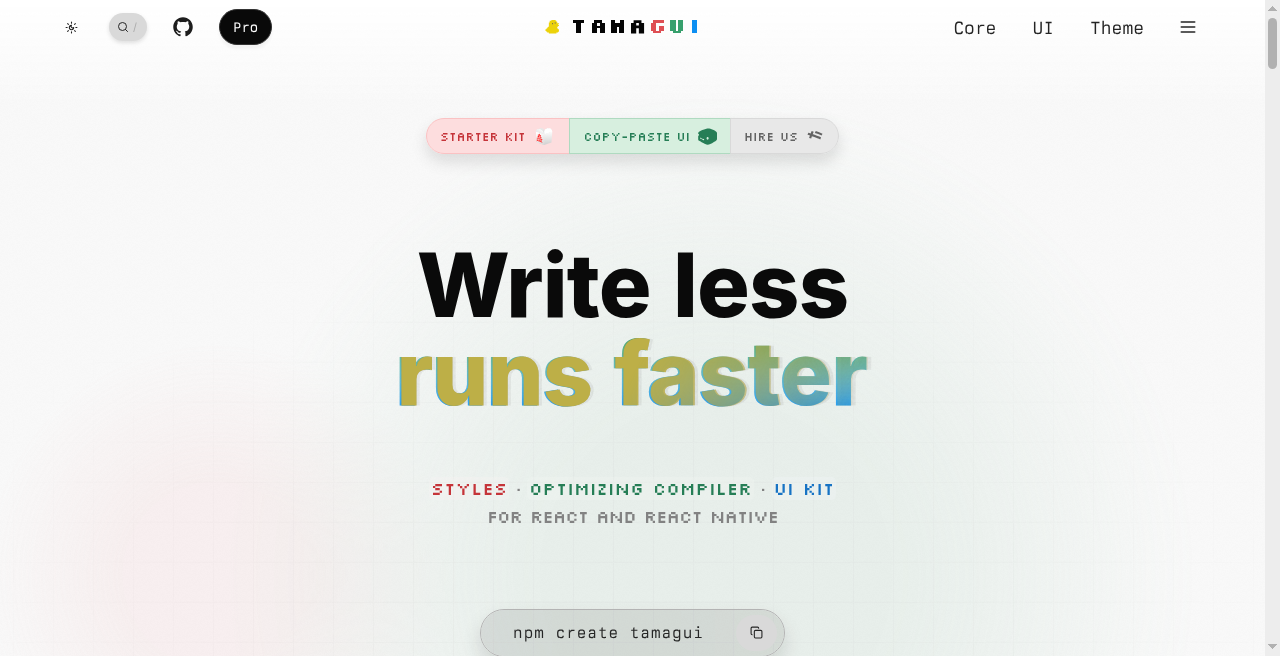
Tamagui's public site splits the product into three layers:
- Core — a style library for React and React Native with a typed superset of the React Native style API (~24KB, no outside dependencies per the homepage).
- Static — an optimizer for partial analysis, CSS extraction, tree flattening, and dead code elimination across Next, Webpack, Vite, Babel, and Metro.
- Tamagui UI — cross-platform composable components with compound APIs, styled or unstyled variants, sizing, and themes.
Installation docs draw the same line: install @tamagui/core for the style library, or install tamagui when you want the full UI kit (a superset of core). Config runs through createTamagui / @tamagui/config, then TamaguiProvider. Native apps currently expect React Native 0.81+ with New Architecture, React 19+, and TypeScript 5+.
That stack is real builder consequence. You get responsive props, themes that behave like CSS variables, compile-time and runtime paths, and starters via npm create tamagui@latest. What you do not get for free is a finished product design system plus backend seams — and that is the decision this post is about.
Engine success is not the same as design-system ownership
Teams confuse two questions:
- Can we share styles and primitives across web and native?
- Who owns the designed Button/Input/Modal vocabulary, the themes agents read, and the product kit around it?
Tamagui answers (1). Question (2) remains a staffing and repo choice. If your plan is "install core, invent 80 components, invent 17 themes, invent auth, invent Stripe," you chose an engine project — not a two-week ship plan. Agents amplify that: they happily styled() new variants all week without knowing which ones are canonical.

One codebase. iOS, Android, and web.
The Fitness Kit ships with auth, a database, and a backend already connected — no setup. Live demo at fitness-preview.otf-kit.dev.
When Tamagui-alone is the right call
Stay on Tamagui (core + your own design work, or the Tamagui UI kit without a full-stack kit) when most of these are true:
- You are building a design system on purpose — library authors, platform teams, or a funded design-system squad.
- You want the smallest universal runtime and will accept owning every composite.
- Compile-time CSS extraction / tree flattening is a measured requirement, not a slogan.
- You already have auth, database, billing, and deploy elsewhere — UI is the only gap.
- Agent docs will name your tokens and allowed
styled()entry points so the model does not invent a second system.
Under those conditions, Tamagui is scope control: buy the engine, own the design.
When the bet flips toward a designed system on disk
Move past "engine only" when any of these show up:
- Product managers expect a finished component catalog, not a primitives backlog.
- You need many designed native screens quickly (fitness, booking, SaaS shells) instead of assembling each pattern from
View/Text. - Theme switching must be picker-driven for non-experts, not a tokens file only senior engineers edit.
- Web accessibility/keyboard patterns matter enough that a Radix-backed web surface is part of the plan (the compare page is explicit that otf-kit uses Radix on web + Tamagui on native for that reason).
- You want agent configs, demo data, and payment/auth seams in the same purchase as UI.
That is the fork at otf-kit vs Tamagui: primitives and engine versus a designed system plus kits. Importantly, it is not either-or forever — the compare page notes you can keep raw Tamagui beside designed components when they share tokens. The decision is what is canonical on day one.
A concrete decision test you can run this week
# 1) Confirm the engine install surface
yarn add @tamagui/core
# or the UI kit superset:
# yarn add tamagui

yarn add @tamagui/config
Then answer out loud:
- Are we staffing a design-system build, or shipping product screens this quarter?
- Which composites must exist in week two (auth forms, paywalls, lists, charts)?
- Who owns tokens if web and native diverge — and what file do agents open first?
- Do we need a backend kit in-repo, or is UI the only missing piece?
If the answers are "design-system team," "we will build composites," "tokens live in tamagui.config," and "backend exists," stay on Tamagui. If the answers point at product velocity, a large designed catalog, or missing auth/billing seams, an engine-only start is debt.
Owned repo outcome (what "switch" should mean)
Switching should not mean "delete Tamagui." On many stacks the native side still is Tamagui under the hood. Switching should mean:
- Canonical designed components with stable names agents can import
- Themes humans can pick without editing token math
- Web and native parity rules written down (including when web uses a different primitive engine)
- Kit-level seams when you need a product, not a Storybook
Pair that outcome with How to build a fitness app with AI you actually own when the mobile path is real, or How to build a SaaS app with AI from a day-1 owned monorepo when the web product spine is the gap.

Migration notes if you already invested in Tamagui
If you stay: pin @tamagui/core or tamagui, document New Architecture / React 19 requirements in agent rules, and publish a short "allowed composites" list so agents stop inventing parallel Button APIs.
If you add a designed system on top:
- Keep shared tokens — do not run two theme owners.
- Replace high-traffic composites first (Button, Input, Modal), then specialty screens.
- Write the web/native primitive rule explicitly (Tamagui everywhere vs Radix-on-web).
- Land kit seams (auth, payments) in the same sprint you freeze the design API, or agents will hard-code demos.
- Treat
npm create tamaguistarters as learning tools, not as production ownership proofs.
Practical checklist
- Goal: design-system build vs product ship this quarter
- Install surface:
@tamagui/corevstamaguiUI kit documented - Canonical composites listed for agents
- Theme ownership named in one file
- Compare page reviewed: /compare/otf-kit-vs-tamagui
Bottom line
Tamagui is a strong cross-platform engine: style core, optimizing compiler, and optional UI kit for React and React Native. The day you need a large designed catalog, picker themes, and a full-stack kit in the repo, the decision is no longer about styled() syntax — it is about which system your agents and humans treat as canonical.
Sources
- Tamagui homepage — Core / Static / UI kit positioning
- Tamagui installation —
@tamagui/corevstamagui, provider setup, RN 0.81+ / React 19+ requirements - otf-kit vs Tamagui compare page
- Tamagui homepage capture — https://tamagui.dev/ public page, 2026-09-15
Stop wiring. Start shipping.
- Login, database, and backend already connected — nothing to set up
- iOS + Android + web from one codebase
- AI configs pre-tuned + 40+ tested prompts included