
RNUI as org design system vs a thinner custom layer
You already standardized on Wix React Native UI Lib (RNUI) for React Native. The library is a full UI toolset: foundations, ThemeManager, modifiers, and a deep component catalog maintained for modern React Native architectures. The question is no longer "is RNUI good enough to start?" It is whether RNUI should be the org-wide mobile design system, or whether a thinner custom RN layer on top of a smaller primitive set will cost less to operate across apps.
This is an org-architecture decision, not a product-kit pitch. Keep RNUI when multi-app theming, RTL, and token ops fit its foundation model. Prefer a thinner custom layer when your apps diverge faster than a shared ThemeManager can absorb.
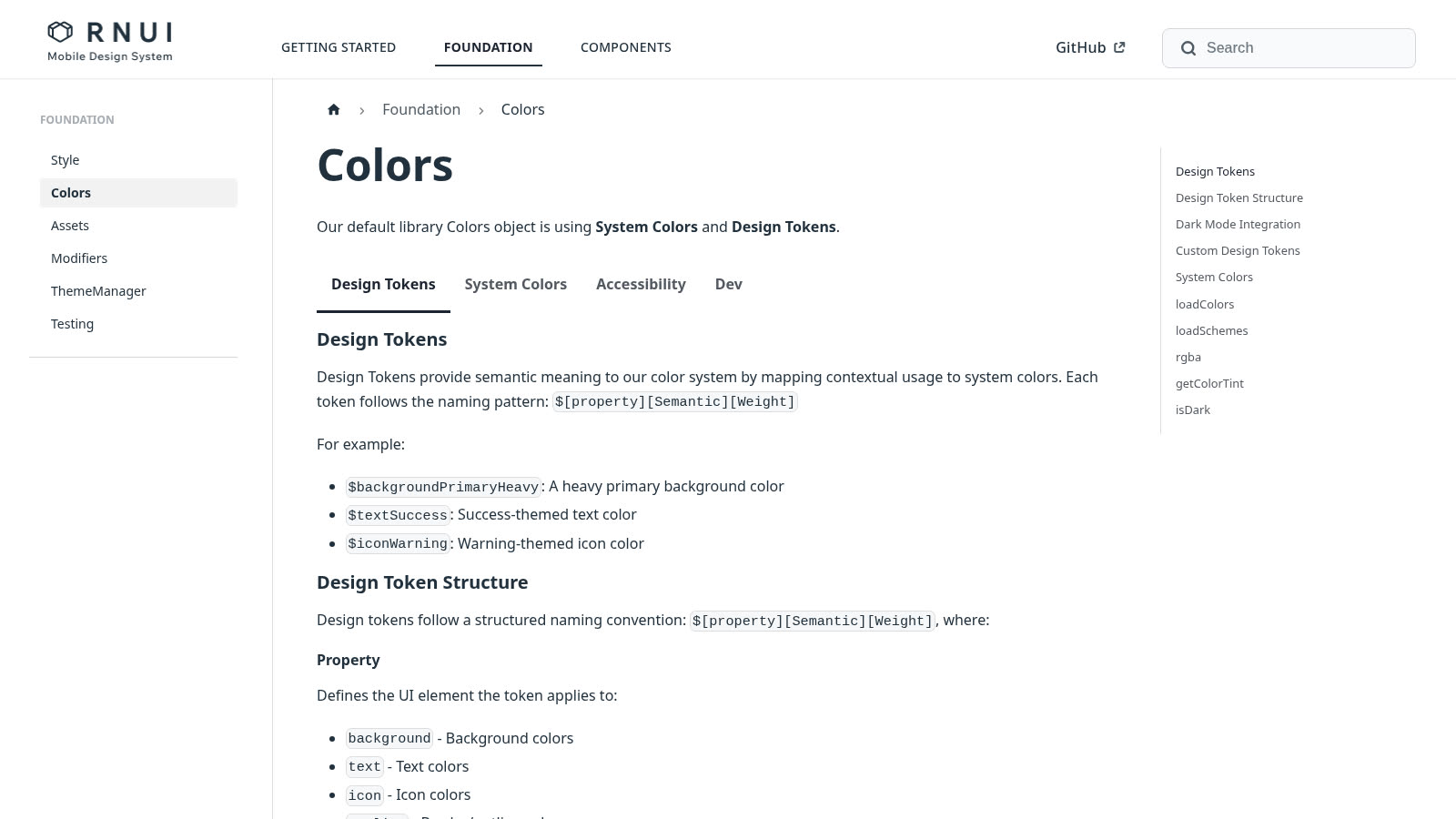
Capture: https://wix.github.io/react-native-ui-lib/docs/foundation/colors on 2026-09-16.
What RNUI gives an org design system
The setup guide installs the library plus mandatory peers react-native-reanimated, react-native-gesture-handler, and uilib-native. Optional peers (blur, datetime picker, SVG, gradients, and related packages) attach only to the components you actually use. That is a serious RN-only bet: one dependency tree, one animation runtime, one gesture stack.
Foundations are the real DS spine. The Colors docs describe system colors plus semantic design tokens named $[property][Semantic][Weight] — for example $backgroundPrimaryHeavy, $textSuccess, and $iconWarning. Tokens map to light and dark schemes. You override with Colors.loadSchemes or seed brand values through Colors.loadColors. Typography and spacing load the same way via foundation loaders.
Defaults live in ThemeManager. ThemeManager.setComponentTheme sets default props (object or callback). setComponentForcedTheme sets defaults that instance props cannot override. That is how an org enforces Button height, Text tone, and Card chrome without chasing every screen.
Appraise this generously: few open RN libraries combine semantic tokens, scheme loading, forced themes, modifiers, and a catalog that includes surfaces like Wizard and Picker under one maintained roof. If your company already ships multiple RN apps and wants one visual language, RNUI is a rational default.
How to run RNUI as the org DS today
Install once per app from the official setup docs:
npm install react-native-ui-lib
npm install react-native-reanimated react-native-gesture-handler uilib-native
cd ios && pod install
Complete the Reanimated native setup the Reanimated docs require. Then load foundations early — before screens import components — so tokens exist when ThemeManager runs:
import {Colors, Typography, Spacings, ThemeManager} from 'react-native-ui-lib'

Colors.loadColors({
  primaryColor: '#2364AA',
  secondaryColor: '#3DA5D9',
})

Colors.loadSchemes({
  light: {
    $backgroundDefault: '#FFFFFF',
    $textDefault: '#20303C',
  },
  dark: {
    $backgroundDefault: '#1E2830',
    $textDefault: '#F8F8F8',
  },
})

Typography.loadTypographies({
  heading: {fontSize: 24, fontWeight: '600'},
  body: {fontSize: 16, fontWeight: '400'},
})

Spacings.loadSpacings({
  page: 20,
  card: 12,
})

ThemeManager.setComponentTheme('Button', {
  borderRadius: 8,
})

ThemeManager.setComponentForcedTheme('Text', {
  color: Colors.$textDefault,
})
Screens then compose with modifiers (padding-page, bg-primaryColor) and shared components. New apps clone the foundation module, not a Figma guess. Agents inherit the same token names if your repo documents them in project rules.
That is the org-DS win: one vocabulary for colors, type, space, and component defaults across every RN binary you ship.
One codebase. iOS, Android, and web.
The Fitness Kit ships with auth, a database, and a backend already connected — no setup. Live demo at fitness-preview.otf-kit.dev.
When a thinner custom RN layer wins
A thinner custom layer means you keep a small set of primitives (View/Text/Pressable wrappers, a token file, maybe one Button and one Text field) and refuse to adopt a full catalog. You write the 20 components your product actually uses. You skip Wizard, ConnectionStatusBar, and every optional peer you do not need.
Choose the thinner path when:
- App brands diverge. Three white-label apps with different radii, type scales, and interaction patterns will fight
setComponentForcedTheme. Forced defaults become a politics problem, not a consistency win. - Token ops outgrow the loader model. If design publishes tokens as CSS variables for web and a separate JSON for native, RNUI's
loadSchemesis one more mapping to keep honest. A thin layer that reads the same JSON the web app uses can be cheaper than dual-writing RNUI schemes. - RTL and density rules are product-specific. RNUI supports i18n-friendly layouts, but if your RTL rules live in custom navigation chrome and density modes the catalog does not express, wrapping RNUI components costs more than owning the few surfaces you need.
- Peer weight is real. Reanimated + gesture-handler +
uilib-nativeare mandatory. Optional peers add more native surface. A five-screen internal tool may not want that install tax. - Maintenance staff is one engineer. A deep catalog needs upgrade discipline when React Native majors move. A thin layer has fewer APIs to chase.
The thinner layer is not "no design system." It is a smaller contract: tokens + 10–30 components + documented usage. You trade catalog breadth for change velocity.
Multi-app theming and token ops (the real cost center)
Org DS cost is not the first Button. It is the hundredth theme override.
With RNUI as the standard, every app imports the shared foundation package. Brand A overrides $backgroundPrimaryHeavy. Brand B loads a different scheme. Both keep the same component API. ThemeManager callbacks can branch on props or context. That scales cleanly when brands are variants of one system.
It breaks when brands are different systems pretending to share a Button. Then you get:
- Forced themes that product teams constantly escape with one-off styles
- Duplicate "almost Button" wrappers in each app
- Agents inventing a third pattern because the docs and the repo disagree
Measure the cost in three ledgers:
- Token ledger — how many semantic tokens are shared vs forked per app
- Override ledger — how many
setComponentTheme/ forced-theme rules exist, and how often screens bypass them - Upgrade ledger — hours per RN major to keep peers and catalog green
If the override ledger grows faster than the token ledger, the org DS is fiction. A thinner custom layer with an honest per-app token file may be cheaper than a shared ThemeManager nobody trusts.
How this sits next to other UI bets
Adjacent posts draw different boundaries. React Native Paper is a Material component system — different visual language, similar "components vs product spine" question. Chakra UI is a web-only React DS decision. NativeWind is utility classes on React Native, not a component catalog. Gluestack UI v5 is a copy-paste universal-components bet with its own platform gates. None of those answer whether your company should mandate RNUI across every RN app or keep a thin in-house layer.
RNUI's honest scope is React Native. If a team also needs the same designed system on web, that is a different decision surface — do not stretch ThemeManager into a cross-platform promise it does not make.
Decision checklist
Answer these before you mandate RNUI org-wide:
- Do at least two production RN apps share one brand language today (or within two quarters)?
- Can design publish tokens that map cleanly into
$[property][Semantic][Weight]plusloadSchemeswithout a second shadow system? - Will product accept
ThemeManagerdefaults (including forced themes) instead of per-screen style escapes? - Is someone named as owner for peer upgrades (Reanimated, gesture-handler,
uilib-native) on every RN major? - Are RTL, density, and white-label rules expressible as schemes and themes — or do they need custom chrome RNUI will not own?
If (1)–(4) are yes and (5) fits schemes/themes, standardize on RNUI and invest in a shared foundation package. If (2), (3), or (5) fail, build the thinner custom layer and treat RNUI as optional inspiration — not the org law.
RNUI is a strong React Native design system when you commit to its foundations and ThemeManager. Use it as the org standard when multi-app token ops stay inside that model. Prefer a thinner custom RN layer when your apps diverge faster than shared defaults can hold — and write that choice down so agents stop reinventing a third path.
Sources
- Wix react-native-ui-lib on GitHub — project positioning as RN UI toolset and components library
- RNUI setup guide — install, mandatory peers, optional dependencies
- RNUI Colors foundation — design tokens, loadColors, loadSchemes, dark mode mapping
- RNUI ThemeManager — setComponentTheme and setComponentForcedTheme
Stop wiring. Start shipping.
- Login, database, and backend already connected — nothing to set up
- iOS + Android + web from one codebase
- AI configs pre-tuned + 40+ tested prompts included