
AI Coding Assistants Face Critical Security Risks: RCE and Supply Chain Attacks
Three agent workflows, one trust-boundary bug
A security write-up (IT Security News, via GBHackers, Aug 7, 2026) describes researcher findings affecting AI coding-agent workflows from Anthropic, Google, and OpenAI. The reported shape of the bug: an attacker-controlled issue or zero-privilege input can breach the trust boundaries of the agent "harness" — the permissions, tools, sandbox, filesystem, and automation wrapped around the model — and result in code execution, secret theft, or workflow compromise.
This isn't a vendor-bashing post. External researchers described a real class of bug, and builders get to ship safer code as a result. But the pattern matters more than any single instance. The same architectural choice — a permissive harness around a capable model — appears across agent systems, and it's a pattern that's going to keep repeating until the harness itself is treated as part of the attack surface.
Here's what the write-up describes, what it enables, and how to keep shipping with AI coding assistants without handing your repo to an attacker.
What the write-up describes
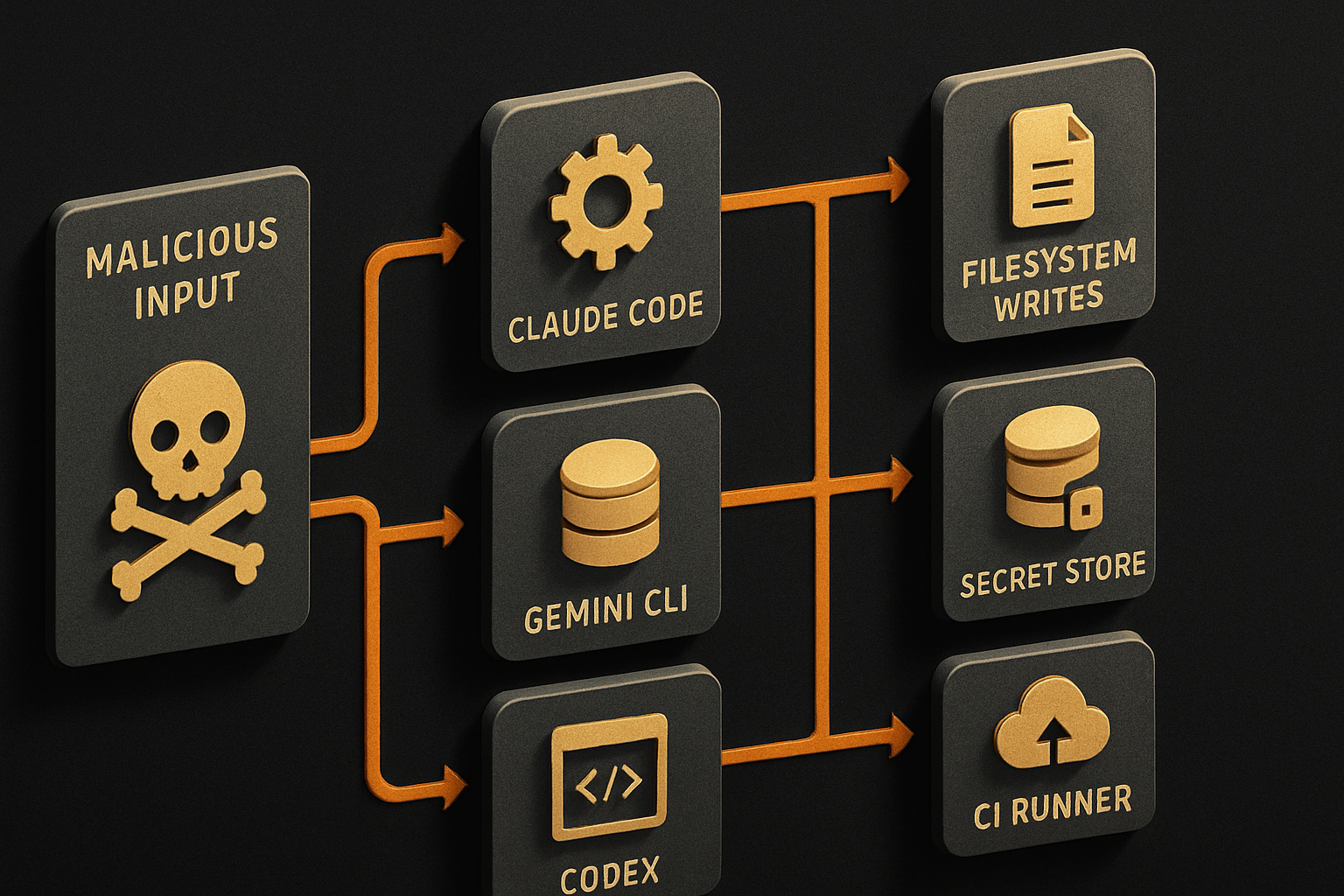
The reported vulnerability class targets the agent harness — the wrapper that gives the model shell access, file edits, network calls, and tool invocations. The harness is what turns a language model into a coding agent. The described class of bug lets an attacker with zero privileges — a GitHub issue, a PR description, a comment on a ticket, an @-mention in a chat channel the agent is wired into — escalate to full code execution on the developer's machine by walking through whatever the harness is configured to trust.
Per the write-up, researcher findings touch the coding-agent workflows of all three vendors — Anthropic (Claude Code), Google (Gemini CLI), and OpenAI (Codex). The framing calls the harness the new perimeter: it's the boundary between "things the model can read" and "things the model can do", and the reported bugs live in that boundary's validation logic.
Why it matters: every team that uses these tools to triage issues, auto-review PRs, or chain agents into CI is sitting inside that harness. When the harness trusts the wrong input, every downstream action — pushing code, reading secrets, calling internal APIs — happens inside the attacker's kill chain.
Same component. Web and mobile. One codebase.
The free, open-source SDK gives you components that work the same on web and mobile — one codebase. github.com/otf-kit/sdk
How the exploit walks the harness
The mechanism is straightforward enough to reason about, and that's exactly why it's dangerous.
- The attacker drops a malicious payload somewhere the agent will read it — an issue body, a PR description, a file in the repo, a chat thread the agent monitors.
- The agent's prompt-construction layer pulls the payload into its context. Up to this point, the model has just "read" the payload — no execution yet.
- The harness then acts on what the model returns: tool calls, file writes, shell commands. The bug is that the harness doesn't reliably distinguish between "instructions from the operator" and "data scraped from an untrusted source."
- The model's output — now shaped by attacker-controlled input — triggers a privileged tool call. That tool call runs in the developer's environment, with the developer's credentials, against the developer's git remote.
The blast radius is whatever the harness can reach. On a developer laptop, that's usually: the entire home directory, the SSH keys, the GitHub PAT in the keychain, the cloud CLI session, and any CI tokens in ~/.config/. In a CI workflow, it's the runner's mounted secrets and the production deploy credentials.
What an attacker can take in a single pass:
| Asset at risk | What the attacker walks away with |
|---|---|
~/.ssh/ | Persistent SSH access to every repo the dev can reach |
| Git remote tokens | Push access, including to protected branches |
| Cloud CLI sessions | Live credentials for the major cloud providers, often unscoped |
Local .env files | Database URLs, third-party API keys, OAuth client secrets |
| CI-mounted secrets | Production deploy tokens, signing keys, registry creds |
This is not a theoretical chain. The write-up names code execution, secret theft, and workflow compromise as the outcomes — treat them as the realistic floor, not the ceiling.
Implications for developers and organisations
If your team uses any of these agents — and most professional JavaScript and Python teams use at least one in some form today — the blast radius extends past the individual developer. A compromised agent that pushes to a protected branch is a supply-chain attack: every downstream consumer of that repo now pulls attacker-controlled code. GitHub's security hub tracks exactly this kind of supply-chain pressure across the ecosystem. A compromised agent with cloud credentials can pivot into your production account and persist access long after the original machine is wiped.
One malicious issue on a public repo → one developer's compromised machine → one poisoned merge → thousands of downstream pullers. The entry point is now an AI coding assistant with a permissive harness instead of a maintainer's compromised laptop.
This is the trust-boundary bug that keeps reappearing. Vendors will patch the specific instance. The architectural pattern — "give the model everything and trust it to be careful" — is what actually needs to change.
How to mitigate this today
Don't wait for a vendor patch. Most of the load-bearing mitigations are configuration choices you can make right now.
Constrain the harness, not the model. The model is going to do what the input tells it to do; that's the whole point of a model. The real fix lives in the harness configuration:
- Pin tool scopes. Don't let the agent run
bash(*)— make it runbash(git:*)orbash(npm test). Whitelist by command, not by category. - Default-deny filesystem writes outside the repo.
/etc/,~/.ssh/,~/.aws/,~/.config/gh/should be read-only mounts for the harness, full stop. - Strip secrets from the runtime environment. Mount a scrubbed view into the agent's process; don't hand it your real
~/.aws/credentials. A tempfile with the keys it actually needs, rotated per run, is a much smaller blast radius. - Block egress to anything not on an allowlist. If a tool call wants to make a network request, it should be one you've explicitly approved.
# Example: a tight harness config (shape only — pin to your vendor's current schema)
{
  "permissions": {
    "bash":    ["git status", "git diff", "npm test"],
    "edit":    ["src/**", "tests/**"],
    "network": ["github.com", "registry.npmjs.org"]
  },
  "filesystem": {
    "writable":  ["./"],
    "readOnly":  ["/etc", "~/.ssh", "~/.aws", "~/.config/gh"]
  }
}
Treat agent output as untrusted input. Don't pipe agent output back into another agent without sanitising. If Agent A reads an issue and Agent B runs the fix Agent A suggested, you've just built a two-stage prompt-injection chain — and the attacker only needs to win the first one.
Run agents in disposable sandboxes. A container or VM you snapshot before and revert after every agent run. If the harness gets popped, the attacker gets the sandbox, not your laptop.
Audit what the agent actually did. Every modern harness ships an action log. Mine it. A git diff post-run that doesn't match the issue you opened it on is a red flag, not a feature.
The part that doesn't change when the agent does
The agent harness will get patched, the next vendor will ship a tighter default, and researchers will describe the next class of bug in a few months. That's the churn layer. The thing that doesn't churn is what the agent is allowed to touch — your repo structure, your component contracts, your config files, your deployment targets. If that surface is small, well-typed, and explicit, every agent that runs against it inherits the constraint for free.
Teams that standardised on a single component kit ship safer agentic code than teams that freestyle. A typed component contract is harder to subvert than a pile of generated CSS — the agent either matches the contract or the build fails, and there's no soft middle where the attacker's payload can land. That contract layer is exactly what OTF templates give you: one typed surface every agent inherits.
The pattern that holds up under adversarial agents is the same one that holds up under adversarial humans: make the safe path the easy path, and make the unsafe path require an explicit override. Defaults do more security work than policies.
The future of agent harness security
Three trends worth watching:
- Harnesses will ship deny-by-default permissions. The vendors know. Expect narrower default tool scopes and explicit opt-in for filesystem writes and network egress.
- Runtime attestation will become table stakes. Cryptographically signing what the harness actually did — every file write, every tool call — so a compromised agent leaves a verifiable trail.
- The community will demand "agent SBOMs". A bill of materials listing which tools, scopes, and permissions a given agent workflow uses, reviewable like a dependency tree.
None of that removes the malicious issue from existence. But it shrinks the blast radius until the next research write-up is a post-mortem instead of an incident.
Keep reading
Sources
- Critical Flaws in Claude Code, Gemini CLI, and OpenAI Codex Enable RCE and Supply Chain Attacks — researcher findings, harness framing, reported outcomes (aggregator indexing a GBHackers original).
- GitHub security hub — supply-chain and malware-advisory context.
Buy once, own the code. Ship with the agent you already use.
- Free, open-source SDK — same component, web and mobile
- Paid kits include AI configs + 40+ tested prompts — your agent reads the whole project
- $99/kit or $149 for everything. No subscription, no sandbox limit.