
Cognizant and OpenAI Unite for Global Codex Hackathon in India
Cognizant just put 10,000 of its own engineers in front of OpenAI Codex across six Indian cities in a single hackathon. One event, six cities, one theme — "Engineering the Frontier" — and a workforce large enough to make the platform question real. The honest read: this is the first public signal that Codex is being treated as a production surface inside an enterprise, not a demo toy.
For most engineering teams, AI coding tools live in a weird half-world. They make slick Loom demos and one-engineer wins, but they rarely cross the chasm into the work a 10,000-person org can actually use. Cognizant just dragged Codex across that chasm in one afternoon. The result, per the company: a hackathon spanning Chennai, Hyderabad, Bengaluru, Pune, Coimbatore, and Kochi, with participants collaborating across cities, attending OpenAI masterclasses, and presenting their prototypes to business and technology leaders at the end.
That's the interesting part. Not the marketing tagline. The fact that someone decided Codex was learnable enough — and stable enough — to drop 10,000 people into at once.
The scale is the story, not the theme
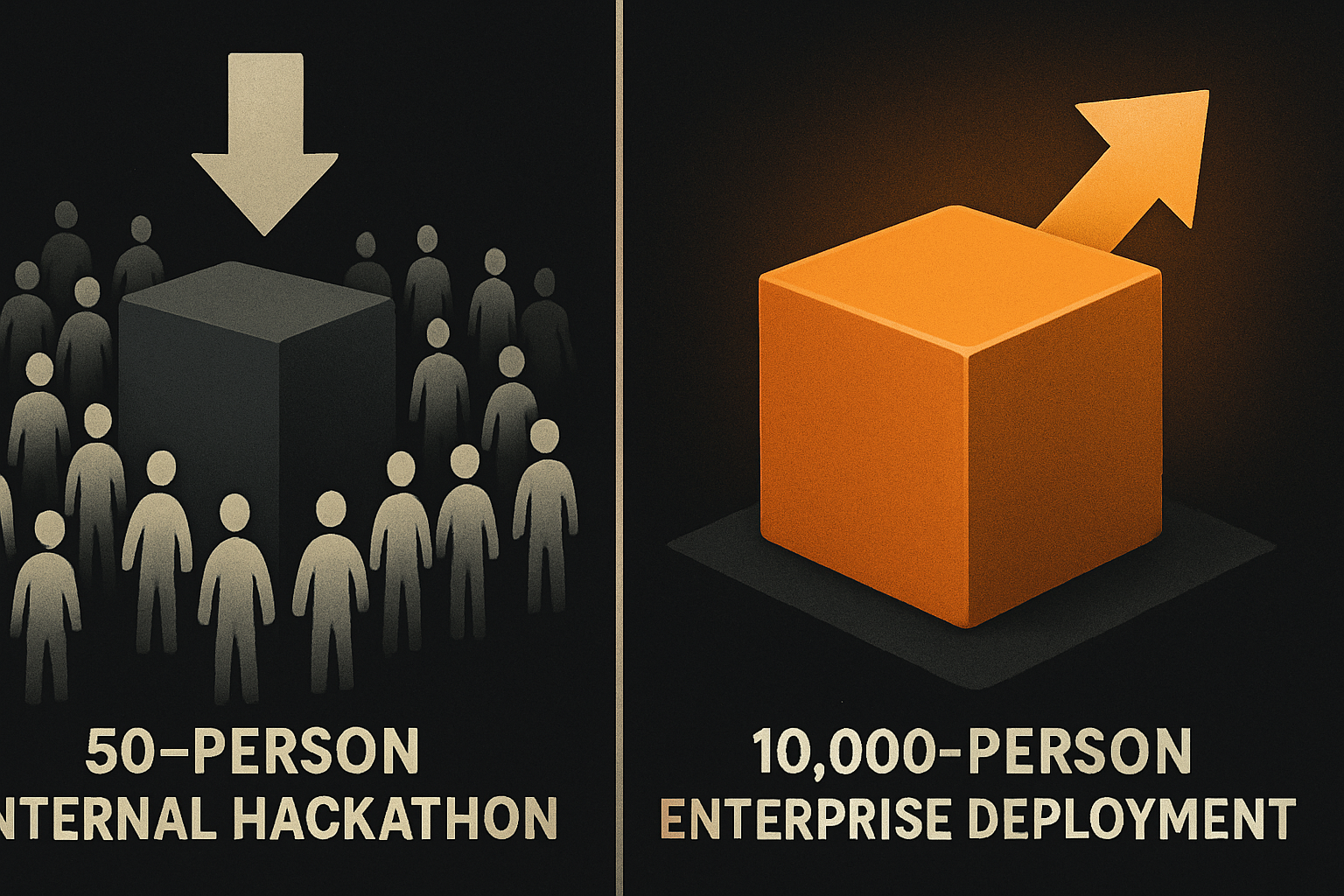
10,000 is a number that flattens whatever skepticism you have about an enterprise AI event. A 50-person internal hackathon can hide bad tooling; a 10,000-person one cannot. If the platform isn't learnable in an afternoon, you get 10,000 confused engineers and zero follow-through. If it is, you get a permanent shift in what your org reaches for first when a new problem lands.
"Engineering the Frontier" is a slogan. The operational reality underneath it is harder: every participant got hands-on Codex time, exclusive OpenAI masterclasses, curated learning resources, and an audience of business and technology leaders at the end. That's a real production line for AI literacy — not a slide deck.
What 10,000 builders in one room does to a platform is the same thing load testing does to a database. It surfaces every rough edge. Which is why this scale matters more than the theme.
Codex-as-named-in-the-article is what 10k builders actually got
The article names OpenAI Codex directly — calling it "one of the industry's most advanced AI coding platforms" — and says participants used it for hands-on problem solving, prototyping, and collaborative sessions. That's the surface that matters: not "AI features," but the specific capability of turning intent into code in a way a non-CS-trained associate can pick up in an afternoon.
The implication for the rest of us is straightforward. If a 10,000-person org can drop people into Codex and get working prototypes out the other side, the on-ramp is shorter than the hype cycle suggests. The risk is treating that on-ramp as the whole job. It isn't. A prototype that lives in a hackathon is a prototype. A prototype that ships to users is a product. Those are very different problems.
Same component. Web and mobile. One codebase.
The free, open-source SDK gives you components that work the same on web and mobile — one codebase. github.com/otf-kit/sdk
How to actually try Codex today
The article doesn't publish Codex setup details — and we won't invent them. What it does confirm is that Codex was deployed as the production-grade surface for real engineering work inside a 10,000-person org. That's enough signal to justify an afternoon.
A pragmatic first session looks like this:
# Codex CLI install + login — see OpenAI's own docs for the current shape.
cd your-repo
codex "add an /api/health endpoint that returns db ping + uptime"
That's the smallest loop that resembles what a hackathon participant actually ran — a real problem, a real codebase, a Codex-shaped assistant in the middle. Run that for an afternoon and you'll know whether Codex fits your workflow the same way the Cognizant cohort did. Treat any specific "X× faster" number cited from the event as marketing — the article doesn't publish accuracy benchmarks, prototype counts, or production-conversion rates, and neither will we.
What an enterprise-grade hackathon reveals about the AI tooling stack
Three things have to be true for a 10,000-person hackathon to ship value, and they're true regardless of which model wins the news cycle:
- The tool has to be learnable in hours, not weeks. A 10k-person pilot won't survive a long on-ramp.
- The platform has to be deep enough to support real work — code generation that holds up to a code review, not just a chat box.
- The durable layer underneath has to survive the model churn. Whatever UI, auth, and component primitives your prototypes lean on will outlive whichever model shipped this quarter.
The first two are Codex's job. The third is the part that doesn't change when the model does — and it's the part most hackathon recaps skip.
The durable layer underneath the tool churn
A 10k-person hackathon produces a flood of prototypes. Most die on the vine for boring reasons: the team spent 60% of their time re-implementing the same button on three platforms, the prototype that won the demo breaks the moment someone asks "does this work on a real iPhone?", and the web build drifts from the native build the day after the hackathon ends.
That's the gap between "we built a thing" and "we shipped a thing." The tool that built the prototype — Codex, Cursor, Claude Code, Bolt, v0, Lovable — is interchangeable. The layer that ships the result is not.
When a hackathon winner has to graduate to production, the durable layer underneath is the same component looking and behaving the same on web, iOS, and Android through one API. Not three implementations. Not a translation step. One component, three platforms, zero re-writes. That's what carries the prototype across the chasm that 10,000 builders just jumped over.
What this gets us
Three takeaways worth keeping:
- Scale is the new credibility floor. When an enterprise runs a 10,000-person hackathon, the platform underneath has cleared a bar a 50-person pilot never could. That's the new credibility floor for AI coding tools.
- The on-ramp is shorter than the hype. If 10,000 non-specialists got to working prototypes in an afternoon, your on-ramp is probably shorter than the article made it sound. Spend an afternoon with the Codex CLI before you decide whether it fits your team.
- The durable layer is the lock-in. The model will churn. The UI layer, the auth layer, the cross-platform primitives underneath the prototype — that's what carries the work to production. Build prototypes freely; lock the foundation in.
A 10,000-person hackathon doesn't prove Codex is the final answer. It proves the question — "can an enterprise actually use this?" — is no longer hypothetical. The next 12 months will tell us which parts of the stack underneath Codex are durable and which were built for the demo. Build the durable parts first.
Buy once, own the code. Ship with the agent you already use.
- Free, open-source SDK — same component, web and mobile
- Paid kits include AI configs + 40+ tested prompts — your agent reads the whole project
- $99/kit or $149 for everything. No subscription, no sandbox limit.