
SpaceX's Cursor Acquisition Raises Concerns Over Code Ownership

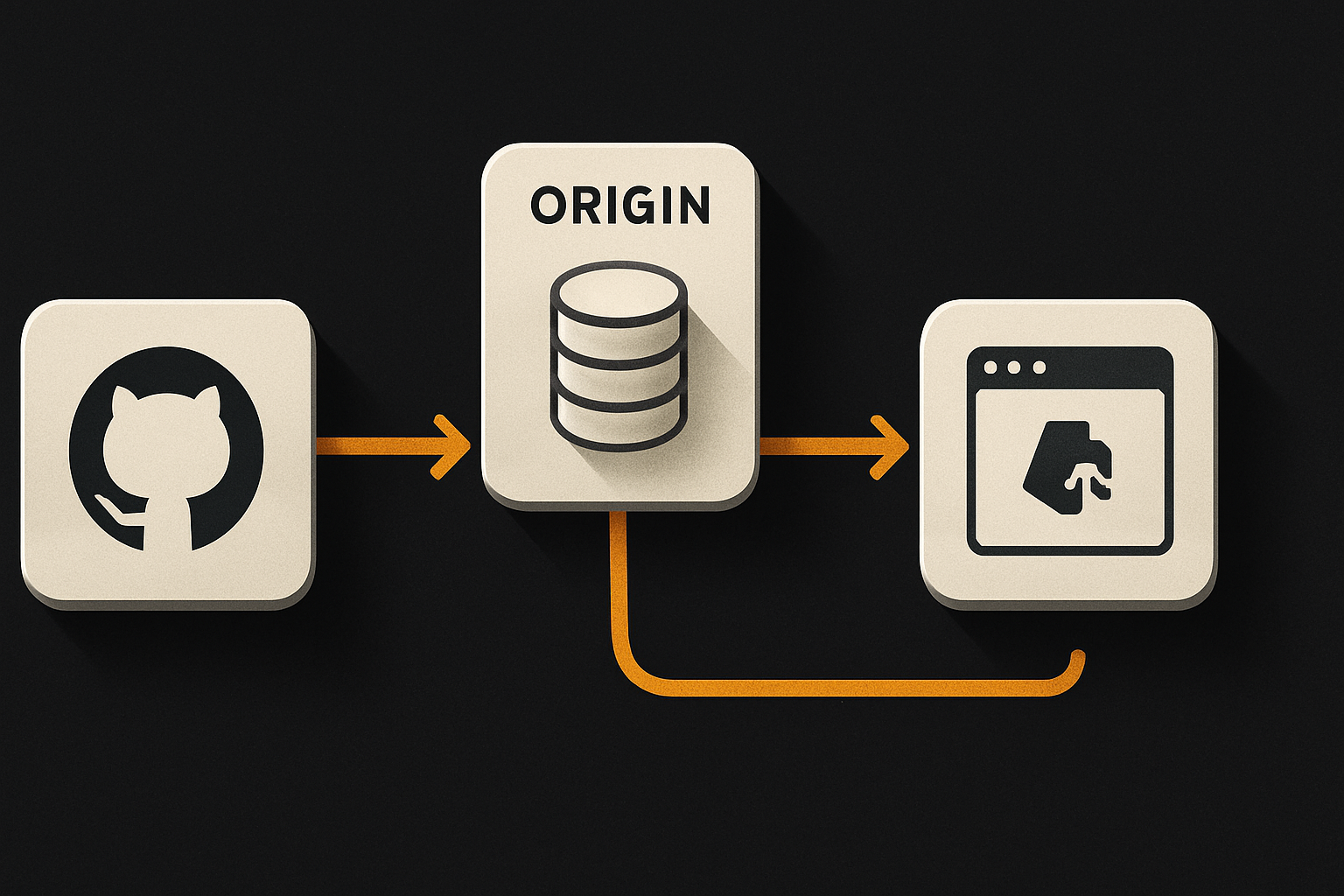
The most interesting thing about Cursor Origin isn't the missing data terms — it's the architecture. Origin is built for agents, not humans. The platform lives inside a new Codebase tab in the Cursor desktop client. Every repository gets its own public URL at cursor.com/codebase/[name]. In early beta, developers can create repositories from inside Cursor — including directly from Cursor agents — clone, push, and pull with standard Git, mirror a GitHub repository into Origin with bidirectional sync, open and review pull requests with comments that post to GitHub within seconds, browse and search code at cursor.com/codebase, and connect third-party apps including Vercel, Depot, and Buildkite for deployment and CI. Full docs are at cursor.com/docs/origin.
The keyword is "agent." GitHub's workflow assumes a human opens a pull request, a reviewer reads a diff, someone clicks merge. That cadence works because humans can only type so fast. AI coding agents discard that assumption. They commit in parallel, open pull requests at machine speed, and never sleep. A platform that hosts repos next to an agent — where the agent itself creates the repo, pushes the diff, and reviews the PR — is a real architectural response to that shift. That's worth saying clearly before any conversation about what Cursor hasn't published, because both things are true at the same time.
What Origin actually does on day one
The feature set is concrete, not vaporware:
- Create repos from inside Cursor, including directly from an agent session
- Standard Git over the wire: clone, push, pull, branches, tags
- Bidirectional sync against an existing GitHub repo
- PRs opened and reviewed inside Cursor; comments round-trip to GitHub within seconds
- Public read-only URL per repo at
cursor.com/codebase/[name] - Web browse and search at
cursor.com/codebase - Third-party integrations: Vercel for deploys, Depot and Buildkite for CI
That last point matters for the architecture argument. A code host that doesn't talk to a deploy pipeline is a toy. A code host that ships with three concrete integrations on day one — and lets an agent provision them — is closer to a working substrate for agent-driven development.
GitHub fell over for four-plus hours on Monday. The coincidence got most of the Twitter attention. The right read is: when an agent-driven pipeline depends on a single host, an outage on that host is a CI incident, not a status-page event. Origin's existence lowers the blast radius of GitHub's next outage — that part of the story is genuinely good.
The four documents that aren't published yet
Cursor's launch-day gap is narrow and specific. As of August 17, 2026, the company has not published:
- Data retention terms for hosted code
- Subprocessor disclosures (who else touches the bytes)
- Training-use policies (whether your code trains any model)
- Migration tooling for moving code out of Origin
That's a complete absence, not a draft. And the rollout is opt-out by default. Every paid Cursor plan — Pro, Teams, Enterprise — is on Origin unless someone explicitly turns it off. Enterprise orgs whose administrators already opted out are excluded; everyone else is in by default.
For comparison, GitHub's terms have been public, lawyered, and litigated for fifteen years. The contrast isn't subtle. You're not choosing between two products with disclosed tradeoffs; you're choosing between one with disclosed tradeoffs and one with no tradeoffs disclosed at all.
11 production screens. Login, database, payments — all wired.
The SaaS Dashboard Kit ships everything already connected. Nothing to set up. Live demo at saas.otf-kit.dev.
The SpaceX timing
SpaceX completed its $60 billion acquisition of Cursor on August 14, 2026 — three days before Origin shipped. The Cursor Origin changelog confirms August 17 as launch day. The two events aren't a coincidence in calendar terms; they're sequenced. SpaceX now holds paid developers' code on a platform with no published policy about what Cursor — now a SpaceX subsidiary — does with it.
This isn't a conspiracy claim. It's a disclosure question. SpaceX is a company whose core work involves proprietary hardware, launch telemetry, and government contracts. Its data-handling posture for a code-hosting subsidiary is not the same as Cursor's independent posture was eighteen months ago, and developers deserve to know the difference. Cursor has not made any statements clarifying that posture, and SpaceX has not issued any.
The pattern that matters here is timing, not motive. When a $60B acquirer closes on a code-hosting subsidiary and that subsidiary ships a hosted-code product three days later under opt-out-by-default terms with no policy documents, the burden of disclosure is on the acquirer. Until it's met, treat the relationship as opaque.
How to host on Origin today without becoming an unwilling data donor
If you're on a Pro or Teams plan, Origin is already on. The opt-out lives in the desktop client settings, but specifics haven't been published in the changelog, so the safest assumption is that nothing about Origin is contractual until the four missing documents exist.
If you're going to keep using Origin in the meantime, treat it like any unproven host:
- Treat every repo as if it will be used for training by default. If that's not acceptable, don't push it.
- Mirror, don't migrate. Use the bidirectional GitHub sync so your canonical home is GitHub, and Origin is a downstream read.
- Strip secrets. Anything pushed to Origin should be safe to publish — rotate keys after, not before.
- Watch the changelog. The first time Cursor publishes a data retention term, read it line by line before the next push.
# Mirror pattern: GitHub stays canonical, Origin is downstream.
# Until Cursor ships migration tooling, this is the safer architecture.
git remote add github  git@github.com:you/repo.git
git remote add origin  cursor@cursor.com:you/repo.git
git push github  main   # canonical source of truth
git push origin  main   # downstream mirror

# PR review round-trip: comments posted in Cursor post to GitHub in seconds
# per docs, so the agent can drive a review loop without leaving Cursor.
If you're on an Enterprise plan and your admin hasn't already opted out, this is the conversation to have this week — before anyone on the team mirrors a real repo into Origin. The four-hour GitHub outage is a useful forcing function here: it shows exactly how much of your pipeline depends on a single host.
The part that survives the host
This is the layer that's easy to miss when the platform underneath changes. Whatever Cursor publishes tomorrow, whatever SpaceX clarifies about subsidiary data handling, and whatever GitHub's next outage looks like — the actual product surface is the same: a cross-platform UI that has to render correctly on web, iOS, and Android from one source. That part doesn't move when the host moves. Whether your repo lives on GitHub, GitLab, Origin, or a self-hosted Gitea, the components shipping to users are the components shipping to users.
Use Origin if its tradeoffs make sense for your team. Use GitHub if they don't. The thing that doesn't change either way is the surface your users touch — and that surface is worth more engineering time than the host debate. Picking the host is a one-day decision. Shipping a UI that holds up across three platforms from one source is a multi-year investment. The ratio is wrong if your team is spending more cycles on the host than on the surface.
What to watch
The four missing documents are the only thing that will actually move this conversation. Until Cursor publishes:
- A data retention term with a clock (how long, then deleted)
- A subprocessor list (who else handles the bytes)
- A training-use clause (yes, no, opt-out, opt-in)
- A migration tool (push to GitHub, GitLab, or a tarball in one command)
...every paid developer's read of Origin should be: "beta, treat as public, mirror not migrate." The first time any of those four documents lands, the read changes — and that's worth paying attention to.
Origin is a real architectural answer to a real shift (agents commit at machine speed, humans don't). It's also a hosted-code platform with no published terms, owned by a company whose core business isn't code hosting. Both of those are true at the same time, and the only rational move is to use it with eyes open until the missing four documents exist.
Ship the product, not the setup.
- 11 production screens — auth, billing, team, analytics, settings
- Real database, payments, and login — all wired on day 1
- AI configs pre-tuned so your agent extends instead of regenerates