
GitLab Vulnerability Exploited Just Days After Public Disclosure

Two days is the new patch window
Two days. That's the gap between GitLab's public disclosure of CVE-2026-19478 and the first in-the-wild exploitation attempts caught by WatchTowr's honeypot network. The vulnerability — a critical code injection bug with a CVSS score of 9.4 — was patched on August 17, 2026. By the following Wednesday, attackers were already probing unpatched instances for the @gl_introduced directive that betrays an exploit attempt.
This is the new reality of vulnerability reproduction and exploitation. The narrow patch window is fueled by AI-enabled attackers who can weaponize an advisory in minutes — WatchTowr reproduced the flaw themselves within minutes of disclosure, armed only with the advisory and the patch diff. If your self-managed GitLab instance isn't on one of the fixed versions, every hour of delay is a coin flip with a credential-less attacker.
What CVE-2026-19478 actually is
The vulnerability is a code injection defect in GitLab's GraphQL API. GitLab's own advisory describes it as an issue that "under certain conditions could allow an unauthenticated user to remotely modify or delete public projects and user data via a GraphQL directive." No credentials. No user interaction. No obscure configuration required. One HTTP request.
Jake Knott, principal security researcher at WatchTowr, put the practical impact in starker terms: "The newly disclosed code injection vulnerability allows an unauthenticated attacker to delete publicly accessible GitLab projects and rewrite their state, deleting repositories entirely, forging merge records, or banning maintainers in a single HTTP request with no credentials, user interaction, or obscure configuration required."
That sentence is worth re-reading. Forge merge records. Ban maintainers. Delete repositories. The CVSS 9.4 is not a rounded-up marketing number — it's an honest reflection of a critical, internet-exposed, pre-auth sink.
The attack surface is every self-managed GitLab instance that exposes its GraphQL API to the network — which, by default, is most of them. SaaS users (gitlab.com) are unaffected; GitLab patched the hosted service as part of the same release.
11 production screens. Login, database, payments — all wired.
The SaaS Dashboard Kit ships everything already connected. Nothing to set up. Live demo at saas.otf-kit.dev.
The exploitation timeline
The arc was short. GitLab shipped patches in CE/EE versions 19.2.4, 19.1.6, 19.0.8, and 18.11.11 on August 17, 2026, along with the public advisory. The next day, WatchTowr warned the flaw was trivially reproducible — they had it working within minutes. By Wednesday, their honeypot network was already catching live exploitation attempts against unpatched instances.
Why so fast? WatchTowr's own statement is blunt: "Whilst no public exploit code is available, WatchTowr was able to reproduce the vulnerability within minutes of its disclosure, armed only with the advisory details and patch. AI-enabled attackers are unlikely to be far behind." The patch diff is the spec. A model that can read a 200-line code change and a GraphQL schema can write the exploit in the same window.
The asymmetry is severe. Defenders must identify affected infrastructure, schedule maintenance windows, and roll out updates. Attackers just need to fuzz ` with a crafted directive. The clock is tilted.
Patch first, mitigate second
The fix is version-bound. If you are running any GitLab version prior to the patched releases, you are vulnerable. Update to one of:
- 19.2.4
- 19.1.6
- 19.0.8
- 18.11.11
For an Omnibus installation:
sudo gitlab-ctl stop puma
sudo apt-get update && sudo apt-get install gitlab-ee=19.2.4-ee.0
sudo gitlab-ctl reconfigure
sudo gitlab-ctl start
Always back up first. If the patch bricks your instance, you want a known-good restore point.
If you genuinely cannot patch within hours — a real constraint in regulated environments with change windows — apply WatchTowr's two recommended mitigations:
- Restrict unauthenticated access to
/api/graphql. A reverse-proxy ACL or WAF rule that requires authentication (or blocks) on this endpoint will defang the attack. - Remove public repository access entirely. The advisory explicitly says "public projects and user data" — private projects are not the target. If your instance doesn't need public repos, take them off the public setting.
# Example Nginx ACL — require auth on the GraphQL endpoint
location /api/graphql {
    if ($http_authorization = "") {
        return 401;
    }
    proxy_pass
}
This is a stop-gap, not a fix. Patch as soon as you can.
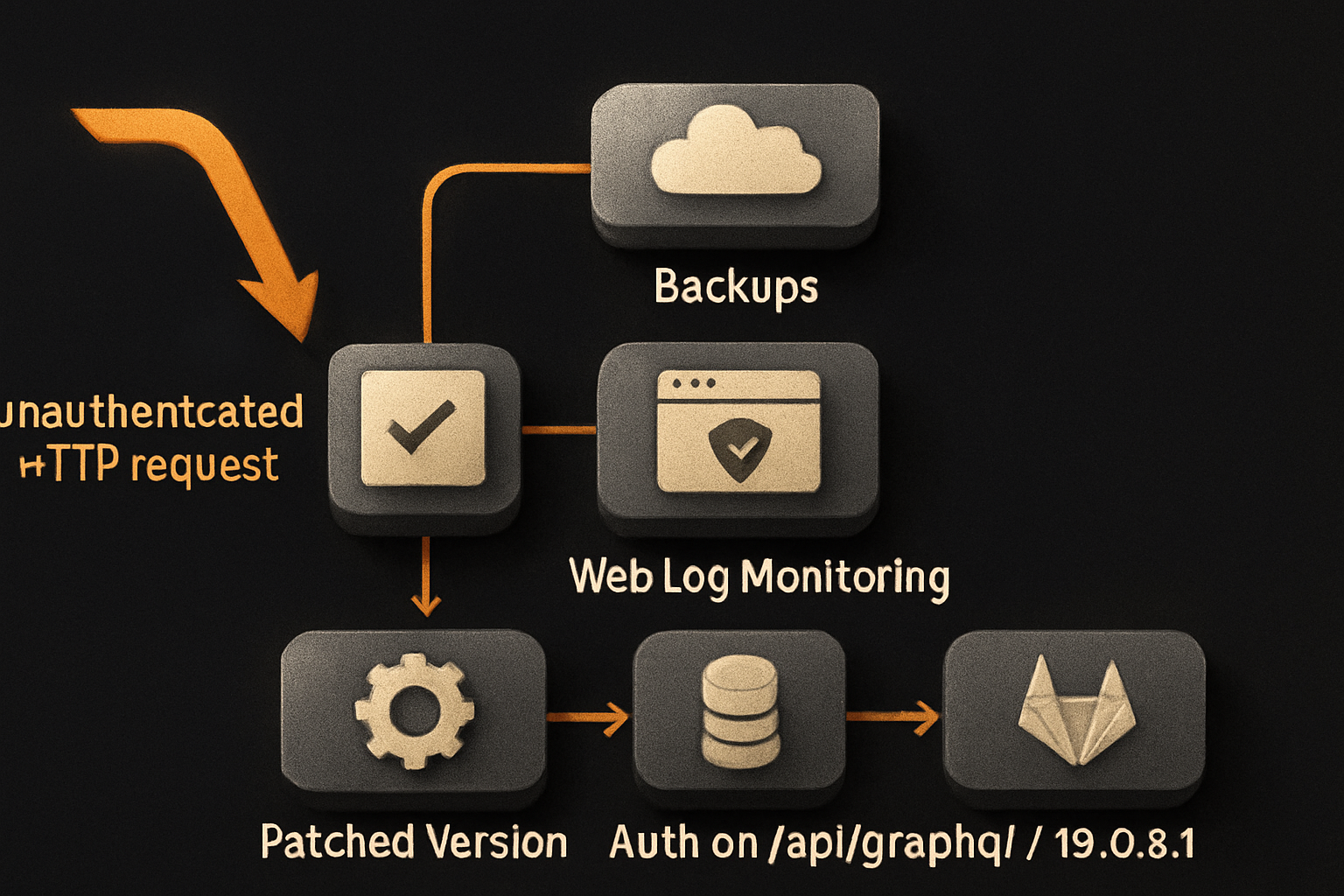
How to check if you're already compromised
WatchTowr's specific advice: hunt your web logs for requests containing @gl_introduced. That string is the GraphQL directive signature of the exploit. If you see it, treat the session as malicious.
grep -r '@gl_introduced' /var/log/nginx/ /var/log/gitlab/ 2>/dev/nullIf you find hits, assume the worst. Check for:
- Deleted or renamed projects
- New merge requests you didn't create
- Banned maintainers you didn't ban
- Modified repository settings
GitLab's audit log is also worth reviewing for the same window. In the UI, that's /admin/audit_log on recent versions. Cross-reference it with the timestamps of any @gl_introduced hits in your web logs.
Long-term hardening
CVE-2026-19478 is the symptom. The disease is the gap between disclosure and patch. A few things shrink that gap:
- Subscribe to GitLab's security advisories. Not the changelog — the security-specific feed. Email or RSS. Skim it weekly.
- Treat
/api/graphqlas a public-by-default endpoint. It is. Authenticate it or firewall it before you patch, and keep that posture after. - Run a versioned upgrade path. Test patches on a staging instance the same day they ship. The 48-hour window is too short for "we'll get to it next sprint."
- Backups. The advisory's worst-case impact is deletion. If your backups are also in GitLab, you have a problem. Mirror to an external system you control — and rehearse the restore.
The pattern repeats with every vendor. The exact endpoint, the exact payload, the exact patch version — all of that churns. The discipline doesn't.
The durable layer underneath
The churn is real: every week, a new high-severity vulnerability, a new vendor, a new patch cadence. The piece that doesn't change is the shape of the codebase underneath — its reproducibility, its portability, its recoverability. A clean, self-contained project tree where the same component renders the same on web, iOS, and Android — one API, one source of truth — is the artifact that survives the next CVE, the next vendor migration, the next repo deletion event.
The tool turns over. The structure of the project doesn't have to.
Ship the product, not the setup.
- 11 production screens — auth, billing, team, analytics, settings
- Real database, payments, and login — all wired on day 1
- AI configs pre-tuned so your agent extends instead of regenerates