
Anthropic's 30-Day Data Retention Sparks Enterprise Backlash
The new policy is real, and so is the engineering behind it.
Anthropic launched Claude Fable 5 and Claude Mythos 5 on June 9, 2026, and shipped a 30-day mandatory prompt-and-output retention policy alongside them. For a company that built its brand on being the safe choice for enterprises, mandating that every prompt to its most capable models gets logged for 30 days — no opt-out, no matter what your contract said — is a notable pivot.
The framing matters. Anthropic isn't doing this to train on your data; they've explicitly said the logs are for safety monitoring — detecting novel attacks, prompt-injection payloads, and vulnerabilities in frontier systems that nobody has seen before. That telemetry problem is genuinely hard at the scale of a Mythos-class model. If you care about a frontier model not getting weaponized the day after launch, you want logs of the weird stuff hitting it. That's the bet, and it's a defensible one.
This post walks through what the policy actually does, why the engineering rationale holds even when the commercial one stings, and — crucially — what parts of your stack you control regardless of how Anthropic, OpenAI, or Google structure their retention rules next quarter.
What the 30-day policy actually requires
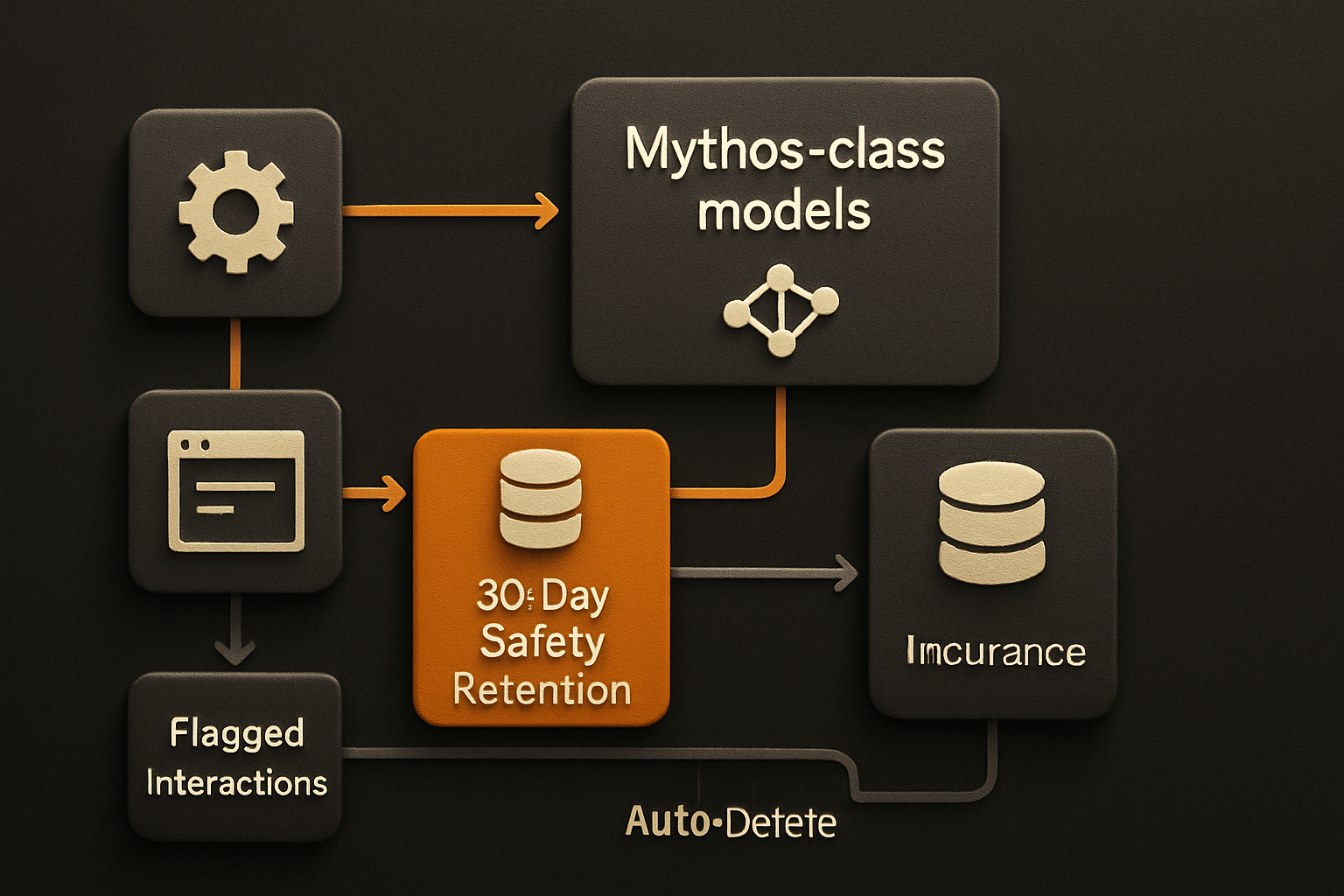
Anthropic will log every prompt sent to and every output generated by Mythos-class models — Fable 5 and Mythos 5 — and retain those logs for 30 days. There is no opt-out. Enterprise contracts that previously specified zero-retention terms are effectively voided for these models.
The retained data is earmarked exclusively for safety monitoring, not for model training. After 30 days it auto-deletes, unless a specific interaction is flagged for a safety investigation or held for legal reasons. The policy applies across first-party and third-party platforms — so even if you're running Fable 5 through a cloud partner, the same retention rule follows the model.
One important precedent: back in August 2025, Anthropic updated consumer terms to allow up to 5 years of de-identified data retention for users who opted into model improvement. Users who declined still faced a 30-day window. The difference now is that the 30-day floor has become mandatory and universal for frontier models, with zero wiggle room.
Why a frontier-safety lab would do this
The honest read: Anthropic is treating its top-end models like high-trust infrastructure. The same way a cloud provider logs every API call against its root-key endpoints — not to snoop, but to detect credential abuse, novel exploits, and misuse patterns — Anthropic is treating frontier-model access as the kind of surface that needs telemetry to be safe to operate.
Frontier models are a category where the failure modes are unknown until they happen. A novel jailbreak, a chain-of-thought exfiltration technique, an emergent capability nobody expected — none of these get caught without observing the traffic. The August 2025 consumer policy was a softer version of the same idea; the new policy is the hard version, because the models are now capable enough to warrant it.
The commercial cost is real. Microsoft reportedly restricted use of Fable 5 within certain internal teams in response — the most visible corporate pushback so far. Enterprises that picked Anthropic precisely because of zero-retention guarantees now have to decide whether the new models' capability is worth the loss of that contract term. Some won't. That's the other half of the bet.
11 production screens. Login, database, payments — all wired.
The SaaS Dashboard Kit ships everything already connected. Nothing to set up. Live demo at saas.otf-kit.dev.
What this changes for teams shipping code through AI
If you're using Claude Fable 5 or Mythos 5 in a build pipeline, a code-review workflow, or an in-product assistant, every prompt you send — and every completion that comes back — sits in Anthropic's retention store for 30 days. That list includes:
- Proprietary business logic you're scaffolding
- Internal API contracts and schemas
- Test fixtures that mirror production data
- Bug reports and stack traces from real customers
- Migration scripts touching production databases
Even with strong contractual language and Anthropic's "not used for training" promise, the storage itself is the new surface. For teams in regulated industries — finance, healthcare, defense — that surface may not be acceptable regardless of the training carve-out. GDPR, HIPAA, and contractual confidentiality obligations don't distinguish between retention-for-safety and retention-for-advertising; they care that the data left your controlled environment.
What you can do today
The retention rule is mandatory, but the choice of what you put through the model is yours. Tier your AI traffic at the client boundary:
// Tier your AI traffic at the client boundary.
// Low-sensitivity work -> frontier model.
// Sensitive work -> local model or none.
async function generate(prompt: string, ctx: RequestContext) {
  if (ctx.containsPII || ctx.touchesProductionSchema) {
    return localModel.complete(prompt)            // never leaves the perimeter
  }
  return frontierModel.complete(prompt)           // subject to 30-day retention
}
For non-sensitive work — boilerplate, public-API integrations, language-specific idioms, test scaffolding — Fable 5 and Mythos 5 are usable as before. Route only the workloads you're comfortable logging.
For sensitive work — production schemas, customer data, internal credentials — keep that work out of any frontier-model context. Run a smaller local model for the sensitive tier, scrub PII before the prompt leaves your perimeter, or skip the model for that workflow entirely.
Review your DPA. The zero-retention clauses you negotiated last year don't bind Anthropic for Fable 5 and Mythos 5 anymore. If that contract term mattered to you when you signed, renegotiate, or move the sensitive tier elsewhere. Microsoft's pullback is the canary — expect more enterprises to follow.
What doesn't change: the component layer you own
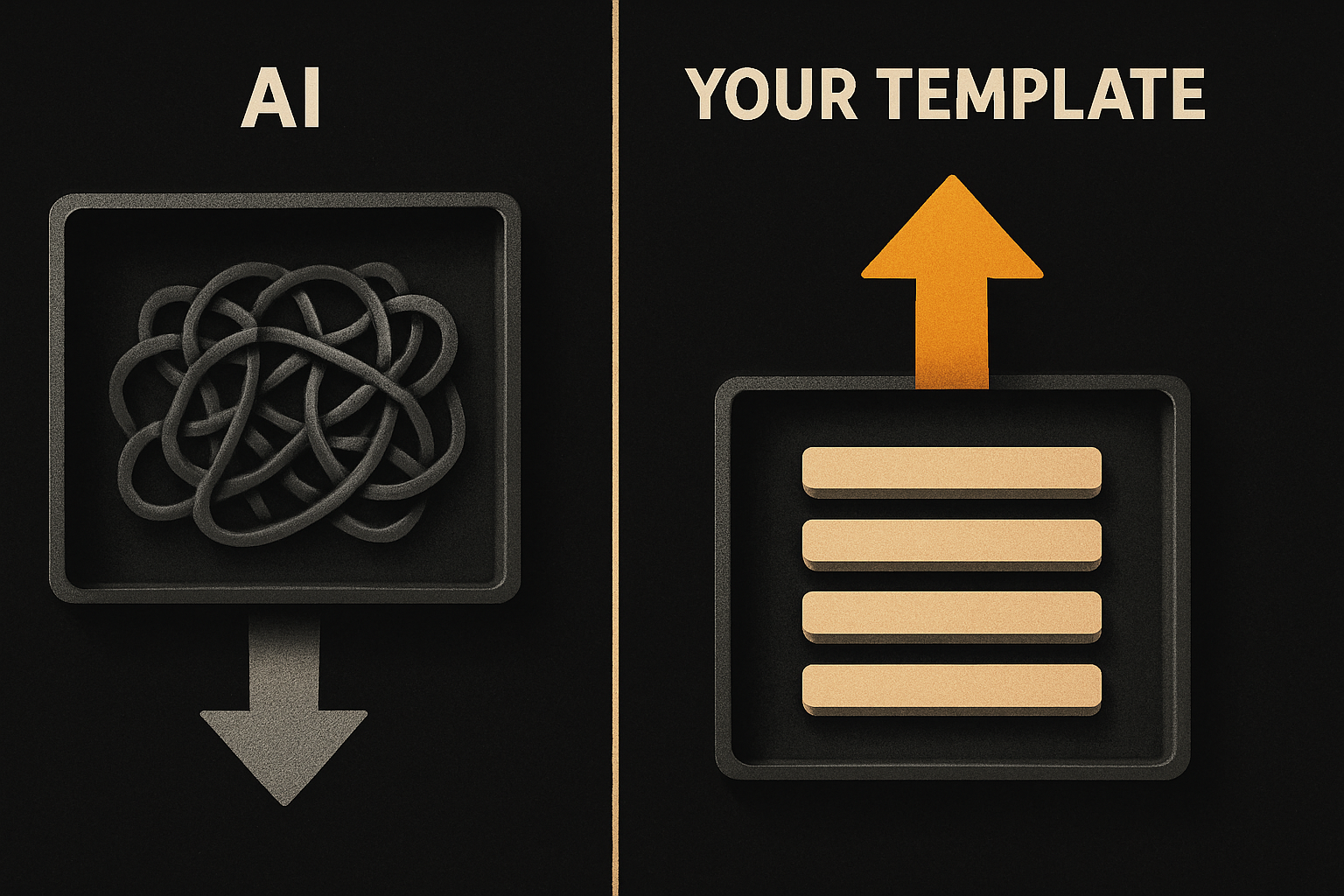
Here's the part of your stack that no retention policy touches. The cross-platform component library, the design tokens, the routing conventions, the auth shape, the schema migration patterns — none of that flows through a model. It lives in your repo, in your template, in your team's head.
This is exactly the layer that OTF gives you. Same component on web, iOS, and Android from one API. Convention over configuration for the parts every app needs. The models above this layer churn — Fable 5 today, whatever ships next quarter, the retention policy du jour — and the durable layer below keeps shipping features unchanged.
When the next retention rule lands, or the next model tier drops, you don't rewrite the component library. You point the scaffolding pass at the new model. The button, the form, the modal — they don't change because the prompt retention policy did.
The takeaway
Anthropic's 30-day mandate is a defensible safety decision wrapped in a painful commercial one. Treat the policy as a constraint on what you send through frontier models, not as a reason to stop using them. Keep the sensitive tier local. Renegotiate the contracts that no longer reflect reality.
And build on a foundation that doesn't care which model holds it up. Use Fable 5 and Mythos 5 where the capability is worth the retention cost. Own the component layer underneath so that the next policy change — and there will be one — doesn't reach your product.
Ship the product, not the setup.
- 11 production screens — auth, billing, team, analytics, settings
- Real database, payments, and login — all wired on day 1
- AI configs pre-tuned so your agent extends instead of regenerates